Showing posts with label Korea-Gangneung. Show all posts

Wednesday, February 1, 2023

Gimpo then and now

My original picture from 2005

Google street view 2015

Google street view 2018

My original picture from 2005

Google street view 2015

Google street view 2018

  Plus ça change, plus ça change. Things happen fast in Korea (Bballi bballi!). I mentioned a few years ago that when I returned to Gimpo in 2018/19, the landscape, both urban and rural, was no longer recognizable as the place I lived in 2005-2006. Not a single thing was in its place anymore.

  One of my favourite walks during my first year in Korea was a narrow country road that wended its way around the contours of a valley. The valley had been used for farming for generations. There were old (100 years old at least) farmhouses settling into the landscape, and moss-covered grave markers on every hill. I had many early birding firsts in this valley of the morning calm. It’s the place I identified, with my Cracker Jack binoculars and fresh “Birds of Korea” field guide, my first Brown-eared Bulbul, Vinous-throated Parrotbill, Black-naped Oriole, and Oriental Dollarbird, among many other common Korean birds.

  I walked the old back road that connected Gimpo and Incheon many times, as it was the quickest way (30 minute walk) to get to and from a friend’s place. I randomly tried to walk the same road using Google Maps the other day, and was surprised, yet not surprised at all, to discover big changes had occurred since 2005. The only two years available on street view were 2015 and 2018. In 2015, there was evidence of massive clearances along the road, with farmhouses and plots being ploughed under, and many of the ancillary buildings along the road being demolished.

  By 2018, everything was gone, and most of it had weeded over in an alarming hurry, as if people had never lived there at all. If that’s where it ended, I’d be cool with it. A quiet valley being restored to nature, roll credits. But I know that’s not what’s going on there. I’m confident that huge new complexes of domino apartments will be constructed there, if they haven't been already. New NDG-sized neighbourhoods being birthed in five short years. Rural being roughly transitioned into urban.

  You can see a hill in the background stripped of trees. This often precedes the actually demolishing of the hill itself – after the trees have been cut and sold, cranes will come and tear the hill down to ground level. I saw it happening in the hills of Suncheon, where they built my whole neighbourhood over a filled-in swamp (Funny side story – the parking lot outside my apartment sank by a foot one day, leaving a corresponding dip in the road. What did the apartment developers do about this worrying structural failure? They painted the dip like a speed bump, as if they’d planned it all along. Well played...). When they ran out of swampland, they levelled a valley, and up went the apartments. I saw the same process in Gangneung – in the six short months I was there, three hills in my neighbourhood were levelled, one of them to expand a grocery store’s parking lot. We’re talking the entire hill – trees felled, dirt and rock picked up and carried off, one dump truck at a time.

  The destruction of habitat in Korea was the most upsetting part of being a birder there. I always grimly joke that if you find a nice quiet birding patch somewhere in Korea, be sure to take a ‘before’ picture, to compare to the inevitable habitat destruction that will surely take place there in short order.

  I wonder if they’ll bulldoze the cemetery hills in Gimpo too, or if the slumbering dead are the only ones immune to ‘progress.’ Stay tuned!

  Anyway, those are my rambling ruminations on a windy winter afternoon. I've been having Verditer Flycatcher daydreams these days.

Sunday, April 7, 2019

Au revoir, Gangneung


Dusky Thrush Turdus eunomus
Stejneger’s Stonechat Saxicola stejnegeri
Black-faced Bunting Emberiza spodocephala
Buff-bellied Pipit Anthus rubescens
  I’ve just wrapped up my Gangneung sojourn – ‘twas the fifth Korean province I’ve lived in, crazy. I’ll miss Gangneung’s scruffy pride, and my old-school farming neighbourhood, which was being carved into by new apartment construction sites as I left. If I return one day, I have a feeling, that, like my return to Gimpo 12 years after living there, it may be unrecognizable to me. Or perhaps it would be like a recent return to Jeju, where I came away feeling wounded inside at the voracious rate of ‘development’ there. The grass is always greener in the past, I suppose, especially when the grass of today is concrete. What?
  Anyhow, I leave with a surprisingly heavy heart – I would have enjoyed experiencing Gangneung’s other two seasons, bird-wise (especially the locally nesting Watercocks, grrrr). As always, I learned a lot about Korea’s birds, as I tried to stuff the gaps in my knowledge, one mistake at a time. I made some progress with gulls, but don’t ever ask me about gonydeal angles, or anything goofy like that, heh heh. Seems I’m not as dialed into the finer points of pipit/wagtail identification as I had convinced myself I was, among other things.
  Well, time to head south…then north, one island at a time! Here’s hoping I head into this spring a bit better prepared to deal with the ‘stimulation overload’ I experienced when I first got to Gageo Island in late April of 2013. One bird at a time.

Gangneung, April 1-6, 2019
  Quiet in the ‘house hills’ on April Fool’s Day. The following day on the river, a first-of-year Common Sandpiper, and six more Red-billed Starlings spotted skulking in low trees at the river’s edge. Where do these birds nest? I’ve seen several species of starling in Korea nesting in hollow metal telephone poles, but I’ve never seen Red-billed nesting, so who knows.

  On the third, I walked the lake for the last time. A mix of only several hundred waterfowl is all that remains on the lake, and almost no gulls left. Of note, two Mandarin Ducks spotted, a half dozen Little Ringed Plovers, a lone Far Eastern Skylark in the fields, a single Barn Swallow, two Dusky Thrush, a female Black-faced Bunting in a spot where I hadn’t seen any all winter (spring movement?), nine Pallas’s Reed Buntings, and my first Common Reed Bunting for Gangneung (my 158th and final species for Gangneung).
  At the tail-end of the walk, I encountered two Buff-bellied Pipits – one showing the familiar pink-orange legs, while the second had dark legs not typical for Buff-bellied. I flipped through the pages in my mental field guide to potential rare species such as Water Pipit, but after puzzling through with a little help from friends, it seems most likely it was just a Buff-bellied with unusually dark legs.

  The next day, I did my final river walk and logged 35 species. A vicious wind ripped through town all day and later into the night, which unfortunately led to the spread of devastating wild fires north and south of Gangneung that night. Two more Mandarin Ducks and only a single Barn Swallow were seen at the start of the walk. Four Red-billed Starlings were again observed skulking low along the river bank, including one pair seen acting territorial around a large bush where I saw similar activity two days earlier. The case for riverside nesting seems to be strengthening. Too bad I won’t be around to confirm this hypothesis, as I too must follow the winds of spring. A lone male Stejneger’s Stonechat was another hint at the torrent of migration that will pass north through Korea this month. Ah, I haven’t observed any Siberian Accentors in town since March 16th.

  At dawn on my last day in Gangneung, I was woken by the staccato burring song of a Dusky Thrush from the hills behind my house. That’s it that’s all.

Sunday, March 31, 2019

Out with a whimper – Gangneung, March 20-31, 2019

Coal Tit Periparus ater
Eurasian Nuthatch Sitta europaea
Large-billed Crow Corvus macrorhynchos
Barn Swallow Hirundo rustica
White-cheeked Starling Spodiopsar cineraceus
Mandarin Duck Aix galericulata
Siberian Chipmunk Eutamias sibiricus
Dione Ratsnake Elaphe dione
(showing drab pre-moult markings)

Odaesan
Sangwongsa Temple
Not used to seeing such old trees in Korea...
Cherry blossoms on the back canals of Gyeongpo
An islet stripped of bushes and scrub, trees mauled...
Sweet progress! Back up those concrete trucks!
'Old school' farm ditches...
...being converted into concrete death traps...
  What to report? Ah yes, more habitat loss – I see examples of it literally every single time I go birding…which is 3-5 times a week. Yep. Preparations continue for a final spring hurrah on the islands, then I migrate too. Spring migration is almost herrrrrre. I must have been high on smog on the 20th when I wrote: Still relatively calm in Gangneung, but the tension, the ‘migration anxiety,’ is palpable out there. Maybe it’s just me, but I can sense the quivering, imminent, potential energy of mass migration like a taught bow, resonating in the wind. What?! How lame does that sound, what was I thinking? Nice adjectives, dude.

  Terrible smog, and much quieter than last week in the hills behind my house on March 20th. Highlight was a possible Grey-capped Pygmy Woodpecker heard on a hill near the original sighting location from back in November – this one not yet visited by the backhoes of progress.
  Seasonal movement was hinted at by several singing leucopsis White Wagtails that were moving through the fields (and past my window at dawn!), the first I’ve seen there. Through the pines, I spied a dark smudge of 200+ Rooks streaming north. Still some restless White-cheeked Starlings around as well.

  Windy and clear along the river the next day. At the mid-river point, the impressive sight of 23 Grey Herons kettling towards migratory altitude, then heading north. Seven individuals changed their minds and peeled back down to the river, perhaps realizing they were in fact local birds.
  Soon after, more visible migration. Over the course of 15 minutes, I watched a vein of 340+ Rooks, composed of smaller squads of 20-50, also on the move. Folded within each of those sub-groups were the requisite 1-3 Daurian Jackdaws. I watched as most of these flocks also circled higher over the river on thermals, before winging with purpose towards the Amur lands.
  Near the river’s mouth, a lone Dunlin paced, my first of the season, followed by a pair of flyby Mandarin Ducks.

  March doldrums still on the river and lake on March 23rd. An evident clear-out of gulls and waterfowl on the lake, with perhaps 60-70% of winter’s numbers gone. The fields were mostly devoid of Far Eastern Skylarks, with only six seen, where there were normally at least 100. Still four Little Ringed Plover and a Dusky Thrush around.

  On March 24th, I finally made it up to Odaesan (Birobong). It’s a hard-ish place to get to, so not many folks were up there on a fresh and windy morning. Lovely. No crazy birds in the temple-ridden hills, with the expected blend of tits, woodpeckers, and nuthatches, as well as a Eurasian Wren, semi-tame Large-billed Crows on the trails, and a Carrion Crow in fields on the way. I was expecting to see a Brown Dipper on the mountain streams – it’s been a while. I had grand winter plans of finding a Spotted Nutcracker in these hills, but I frittered away the one true month of winter we had here obsessed with finding a Black Woodpecker. Fair trade-off, I regret nothing.

  First Barn Swallow of the year on the 29th, lazy over the river towards noon. A lone Red-billed Starling was observed skulking at the river’s edge, acting wary, creeping around where mud meets brush.

  I walked the Namdae River and Gyeongpo Lake the following day. Still overall quiet, with more clear-out of much of winter’s birds, but still no real influx of migrants expected for another week or two. Five flyby Mandarin Ducks at the river’s mouth were notable. At the Plumbeous Water Redstart spot, a Grey Wagtail on territory, but no PWR.
  I was surprised, but perhaps I shouldn’t have been, to find an audacious example of habitat destruction at a formerly scrubby islet. This little oasis in the river has always been ‘birdy,’ teeming with resident birds all winter, and sheltering migrants, including warblers, last October. All of the scrub, and many of the mature trees have been stripped, with the backhoes peeling everything back to bare soil. Did an excavator reach across to do this? Why the hell would this be done? Surely this islet is too small to host a building? Reduction of brush to prevent fire risk would make little sense, as…it’s surrounded by water. Anyway, gross.
  The lake was besieged with clots of extremely festive weekenders taking selfies with the cherry blossoms. Of note: no Skylarks; two more Mandarin Ducks; 9 Falcated Ducks; two low-flying Eurasian Sparrowhawks heading north over the lake together; 8 Little Ringed Plovers; White Wagtail activity on the rise, with at least 30 along the various small waterways (lugens, ocularis, and leucopsis); 20+ Daurian Redstarts, bunched up in places; a singing male Blue Rock Thrush; a skulky Dusky Thrush still; still a dozen Pallas’s Reed Buntings; 25+ Rooks on the move; groups of 20-40 White-cheeked Starlings out and about.
  In the fields, I nearly tripped on my first snake of the season, a Dione Ratsnake. It had more subdued/washed-out markings than I’ve ever seen. Apparently their markings are muted right before shedding. Thanks to Dr. A.B. again for the tip.

  On the final day of the month, several Goldcrest still in Disappointment Valley, but no signs of the Ural Owl I heard there exactly one lifetime ago. No Black Woodpeckers spotted or heard, but plenty of evidence of recent feeding activity on their favoured ‘old-growth’ ridge.
  Coal Tits were in full song, and quite bold in approaching me closer than arm’s length, I thought. Three Eurasian Siskins were spotted in almost the exact same spot (a stand of birch and pines high on a ridge) where I saw a dozen back on January 5th – the only Siskins I’ve seen in Gangneung.
  I was surprised to find a skulky Tristram’s Bunting up near the peak of a ridge. I got good looks at it – it was not a breeding-plumaged Rustic Bunting. My first thought was that it was an extremely early migrant, but my memory ticked over to when I encountered six Tristram’s in similar habitat on Jeju in early March. I dug through the Birds Korea archives and came across several records of Tristram’s being recorded in winter (and summer!) in this part of the country – so it seems not all Tristram’s Buntings are passage migrants here. Cool!
  Back in town, a squadron of 25 Barn Swallows revelled in the strong winds, and skimmed low on the river where the lone scout was spotted two days earlier.

Sunday, March 17, 2019

Otter stuff from this week – Gangneung, March 15-17, 2019

Imperial Star Destroyer makes a low pass over the Gyeongpo fields
Looking west on a rare smog-free day
The same view, as normally seen in the smog
Eurasian Kestrel Falco tinnunculus
Meadow Bunting Emberiza cioides
Rustic Bunting Emberiza rustica
Little Bunting Emberiza pusilla

Yellow-throated Bunting calling and singing
(note: videos play clearer on the second play)

Vinous-throated Parrotbill Sinosuthera webbiana with nesting materials
Buff-bellied Pipit Anthus rubescens

Buff-bellied Pipit foraging

Little Ringed Plover Charadrius dubius
Green Sandpiper Tringa ochropus
Eurasian Otter Lutra lutra (chewing on a fish)
Eurasian Otter Lutra lutra
Eurasian Otter feeding (note: noisy video)

egg sacs belonging to Brown Frog Rana uenoi

  Smoggy on the Namdae River, early on the morning of March 15th. Birdsong resounded from budding clumps of flowers, and there were bees on trees. Daurian Redstarts were acting particularly frisky, with males singing and chasing both females and other males around in exuberant figure-eights through the brush. Vinous-throated Parrotbills were seen nearby with nest-building materials, and waterfowl numbers were gently on the decline.
  The highlight was my first proper sighting of a Eurasian Otter. It fed and cavorted on a worryingly polluted stretch of river. I pointed it out to some passing locals, and they seemed shocked.


  No smog the following day, with lovely mid single-digit temperatures and a blustery blue sky. I logged 47 species on my 100th birding walk in Gangneung, with more signs of seasonal shift noted. These included my first Grey Wagtail since October 8th, and crisply-marked White Wagtails singing and jousting on the river.
  Around Gyeongpo Lake, there were signs of a modest arrival of Little Ringed Plovers, with several groups of 2-3 observed resting on a variety of muddy habitat. Common Pochard numbers were down to about 120. A Green Sandpiper and 60+ Far Eastern Skylarks were notable in the surrounding fields. More rollicking Daurian Redstarts and White Wagtails at every turn, while several Buff-bellied Pipits, Meadow, Little, and Rustic Buntings were observed. Brown Frog (Rana uenoi) egg sacs were seen in a small creek – thanks again to Dr. Amaël Borzée for the ID help.


  On March 17, there was no smog…two days in a row? Breathe in that sweet sweet O2 while you can folks! Along the river, more signs of winter’s end were counterpointed by fresh examples of casual habitat destruction. Grey Herons showed bright breeding bills, while Great Egrets preened their new veils of nuptial feathers. At the photog spot, eight smartly-plumaged Northern Lapwings in a tight group seemed to be passing through, when compared to the several that frequented the area in wintrier times.
  Nine White-cheeked Starlings were spotted nearby, and also had the feeling of seasonal movement about them. A Bull-headed Shrike did an impressive White Wagtail impression near the river's mouth. In the harbour, 60+ Ancient Murrelets bobbed among the swarms of gulls, which were mostly Black-headed (900+). No sign of the Plumbeous Water Redstart, after a half-hearted stakeout.

Friday, March 15, 2019

Let’s get Redstarted in here

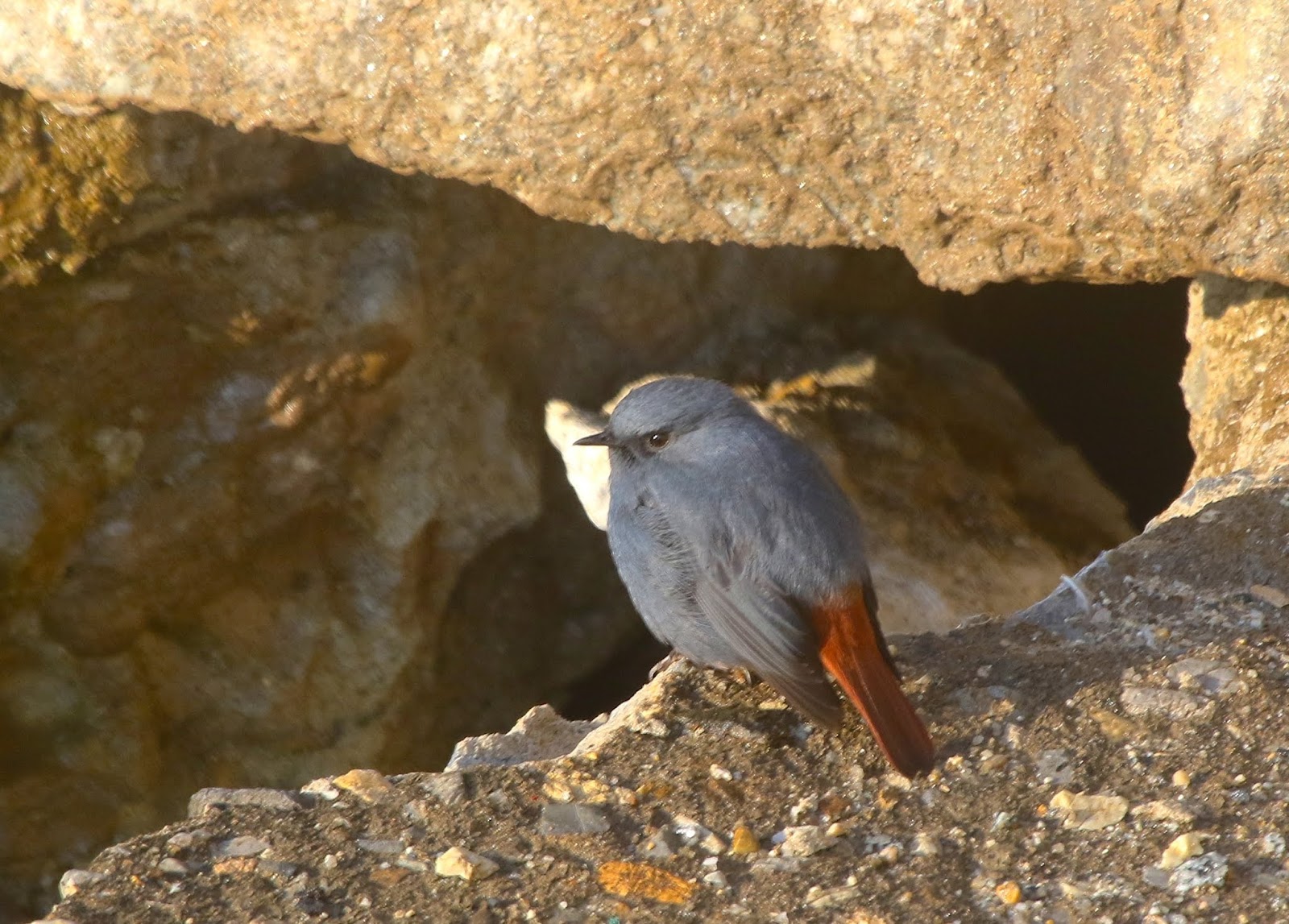
Plumbeous Water Redstart Phoenicurus fuliginosus


  I spent a couple of years on Jeju trying hard, so hard, wishing on a star, to find ‘my own’ Plumbeous Water Redstart. That never happened, and it eventually led to me being confronted by an incredulous official whilst lurking about behind a sewage plant. Sorry sir, official bird business, go back to your station, these aren’t the droids you’re looking for. I ended up twitching one in Gimpo in 2014, and while it was nice to finally observe this enigmatic vagrant, lining up with a phalanx of other twitchers is not how I usually like to enjoy my birds.
  So consider me shocked when, at the tail-end of a lazy river ramble yesterday, I spied movement on the far bank, and caught a brief glance of a rich blue-grey ping-pong ball and a flash of deep orange…before it evaporated. I furrowed my brow and cursed in French. A profound “Am I just seeing shit again?” moment. I didn’t have the time to pursue the bird properly, as I had somewhere to be. I knew what the bird was, but wasn’t quite ready to believe myself, even after securing ridiculous long-range smudgy images.
  This morning, stupid early, before the sun was up, I struck out towards the river with a mission. After a 45-minute stakeout, and with heavying lids, the flame-tailed river chub-elf appeared again. Plumbeous Water Redstart! I did thirty backflips, then got busy watching this stunning bird. I observed it for an hour, which broke down thusly:
  -foraging/tail-fanning in the open: 5 minutes
  -being chased around by a male Blue Rock Thrush: 15 minutes
  -unseen after being chased: 20 minutes
  -sitting immobile on a semi-hidden perch: 20 minutes

  All that to say, it’s not an easy bird to spot – small, dark, silent (as far as I observed), and unobtrusive. I have this queasy feeling that it could have been there all winter, and I only spotted it yesterday, in spite of birding in that exact spot precisely 33 times since early October. Headsmack. Flame-tailed River Chub-elf!

Sunday, March 10, 2019

Vernal Grumblings II – Gangneung, March 8-10, 2019

Koreas, now and then
Part of a huge cloud of (mostly) Black-headed Gulls, put up by an Eastern Buzzard
Mandarin Duck Aix galericulata
Falcated Duck Anas falcata
Eastern Spot-billed Duck Anas zonorhyncha
Great Crested Grebe Podiceps cristatus
Black-headed Gull Chroicocephalus ridibundus
Ring-necked Pheasant Phasianus colchicus
Eastern Buzzard Buteo japonicus
Red-billed Starling Spodiopsar sericeus, with two White-cheeked Starling Spodiopsar cineraceus (look for white rumps and unspotted wings)
Japanese Wagtail foraging
(Note: videos play clearer on the second play)

  Smoggy and mild on the Namdae River on March 8th, with more signs of the seasonal change that is slowly spooling up. Two Great-crested Grebes attired in smart breeding plumage were already engaging in their gentle courtship dance. A pair of Falcated Ducks foraged mid-river – my first sighting of a breeding-plumaged male in Gangneung (at least I have no problem IDing those, ha ha). Only a handful of Eurasian Coots left at the river mouth, and nearby, several Pallas’s Reed Buntings, most on their way towards breeding plumage. There was a bump in PRB numbers a couple of weeks back. Still large numbers of Black-headed Gulls (700+), with some showing the first signs of their namesake breeding hoods. 

  The following day at Gyeongpo Lake, a full circuit of my favoured spots turned up 46 species in three hours. Finally, a day with no smog! It’s a grim state of affairs when a day of breathable air is something to write home about. The air quality in Korea wasn’t anywhere near this horrific just a few short years ago, not even close. Whinge whinge whinge.
  Large numbers of Common Pochard (650+) were crowding up on the lake, with overflow spilling out onto ancillary waterways. Got good looks at a Ring-necked Pheasant while searching for a vanishing Dusky Thrush. No sign of last week’s Japanese Bush Warbler, perhaps there were too many noisy park visitors in its formerly quiet corner of the park. It did seem to be an exceedingly shy and skulky bird.
  Grey-capped Greenfinch were seen to be flocking up more than earlier in winter, with a group of 60+ being the largest. A lone Hawfinch confused me for several minutes, until I secured a brief view of its stonking great big bill. A ripple of at least 110 Far Eastern Skylark over the fields seemed geographically restless.


  I walked the river on March 10th, and was met with stout wind and fresh air in the morning that succumbed to showers and, you guessed it, smog in the afternoon. The river had risen noticeably from just two days earlier, most likely swollen with snowmelt.
  A pair of Mandarin Ducks was sighted on the stretch near my house, and was shortly followed by a pair of Falcated Ducks. Two 
Long-billed Plovers were also notable on this section of river. A flight of at least 90 Red-billed Starlings wheeled along the river with two White-cheeked Starlings folded in. I spotted them at a point about 45 minutes (on foot) away from my neighbourhood – I guess that’s where they’ve gone! Perhaps there are more fruit trees around there, as the ones in my area have been pretty well eaten out.
  Common Gull numbers were way down, from hundreds last month to just a handful. The ranks of Black-headed Gulls, on the other hand, have more than doubled in just two days, with a conservative count of 2,100 near the river’s mouth.
  Hmm, I haven’t seen any Northern Lapwings since February 23rd.