Saturday, January 31, 2009

"Historical post" - Jeju Island, January 2009

Seogwipo waterfront behind my apartment
One of Jeju's iconic but vanishing diving grannies, the tough-as-nails Haenyo
Jeju Island, January 30-31, 2009
  Tim Edelsten came down for the weekend in search of two grey Jeju specials - Grey Bunting and Pacific Reef Egret. The former wasn't found at a once-quiet spot near Jeju City, and we only got a brief glimpse of the latter the following day in a continual downpour. Was good to hang out with Tim though.


Long-tailed Duck Clangula hyemalis
Chinese Grey Shrike Lanius sphenocercus
Shiwha (Near Seoul), January 25, 2009 (With Tim Edelsten)   
  I met up with Tim Edelsten on a frigid trip up to Seoul - meeting my fellow first Birds Korean after birding in Korea for years! At first he questioned my dubious headgear choice (may have been a rainbow tuque), but we got on fine.
  Usually quite serious, Tim practically levitated with ecstasy after getting scope views of two Long-tail Ducks. We also had a dozen White-tailed Eagles on the ice, a Chinese Grey Shrike, and a decent waterfowl assemblage, but my favoured encounter of the day was with an enchanting flock of Chinese Penduline Tit, which had Tim scratching his head and giving me the side-eye, ha ha.


Western Osprey Pandion haliaetus
Black-throated Loon Gavia arctica
Striated Heron Butorides striata
Eastern Spot-billed Duck Anas zonorhyncha
Grey Wagtail Motacilla cinerea
Yellow-browed Warbler Phylloscopus inornatus
Warbling (Japanese) White-eye Zosterops japonicus
Seogwipo, Jeju island, January 17, 2009
  A glorious warm day for birding in Seogwipo. Over the harbour, an Osprey hovered and glided for several minutes, while a Black-throated Loon bobbed in the water close to shore. Two flocks of about 20 Dusky Thrush were seen in bushes overlooking the harbour.
  A short distance away, there was a lot of bird activity in a ‘resting place’ along a small river. Common and Green Sandpipers, a Striated Heron, several Spot-billed Ducks and a Common Kingfisher were spotted in and around the river. Both White and Grey Wagtails, and Olive-backed Pipits paced on the grass.
In the trees and bushes nearby, a Yellow-browed Warbler was seen near some Japanese Bush Warblers, while Japanese White-eyes moved actively through the treetops. 


Greater Spotted Eagle Aquila clanga
Northern Shoveler Anas clypeata
Common Coot Fulica atra escorting a Gadwall Anas strepera
Chinese Pond Heron Ardeola bacchus
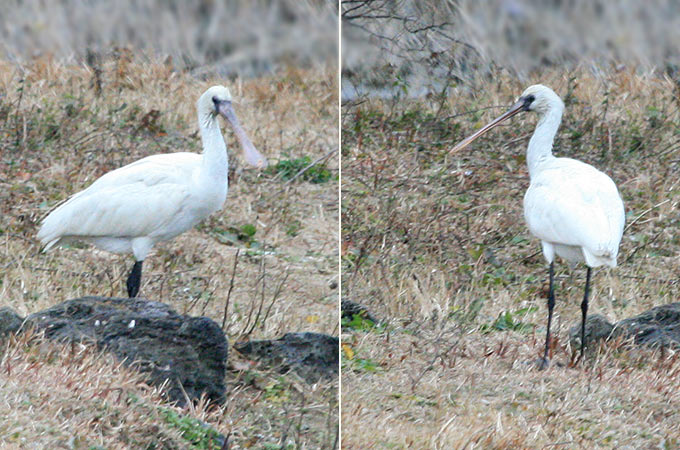
Black-faced Spoonbill Platalea minor
Northern Lapwing Vanellus vanellus with Common Greenshank Tringa nebularia
Meadow Bunting Emberiza cioides
Bird News from Matt Poll & Mike Balfour
Hado-ri and Seongsan-po, Jeju island, January 4, 2009
  Chilly and overcast, but a great day for birds, with 45 species listed. At Hado-ri, huge numbers of Eurasian Wigeon, Tufted Duck, Coot, Common Teal, and Temminck’s Cormorant were seen. Smaller numbers of Common Shelduck, Northern Shoveler, Gadwall and Common Pochard were also seen. Several Dusky, Pale, and White’s Thrush were found in the scrub at the water’s edge.
  We were surprised to see a Black-crowned Night Heron and winter-plumaged Chinese Pond Heron flush simultaneously from a large ditch. An immature Greater Spotted Eagle circled above a small hill, while a Peregrine Falcon and Osprey hunted nearby. A single Black-faced Spoonbill paced up and down the shore with several Great Egrets. Eight Northern Lapwings and a single Common Greenshank were seen near the road as we were leaving.
  At Seongsan-po, similar large numbers of ducks were evident, with several Pintail and Common Goldeneye seen. A handful of Meadow Buntings, and Grey-capped Greenfinch were seen in undergrowth near the sewage plant.


Warbling (Japanese) White-eye Zosterops japonicus
Brown-eared Bulbul Hypsipetes amaurotis
White Wagtail Motacilla alba lugens
Blue Rock Thrush Monticola solitarius
Bull-headed Shrike Lanius bucephalus
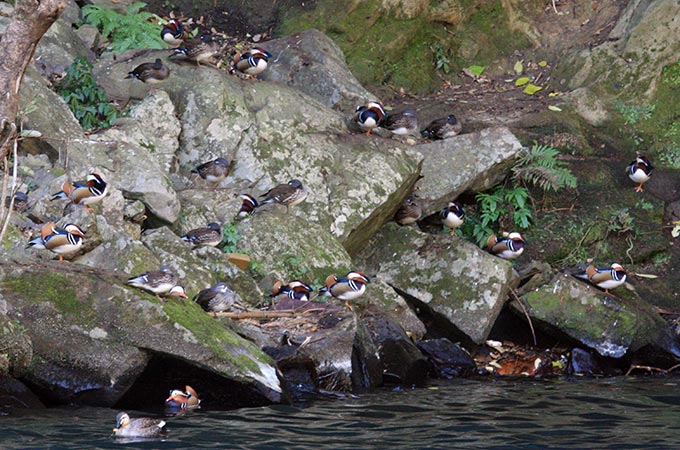
Mandarin Duck Aix galericulata
Japanese Bush Warbler Cettia diphone

Nun-kot - "Snow flowers"
Hiking Mount Halla
Seogwipo, Jeju island, January 3, 2009
  A beautiful warm and sunny day in Seogwipo. Thirty species listed for the day, five of them lifers for me. Noisy Japanese White-eyes and Brown-eared Bulbuls seemed to populate most of the overhanging trees. Common Sandpipers, lugens White Wagtails, Grey Wagtails, and Blue Rock Thrushes were plentiful by the harbour. Two Pacific Reef Egrets hunted patiently by some tidal pools. Two pairs of Great Crested Grebes could be seen a bit further out from the shore. Several Common Kingfishers, Little Grebes, Pale and Dusky Thrush, Bull-headed Shrikes, and Large-billed Crows were also seen in the area.
  Cheonjiyeon Falls held some interesting species, such as a single Coot, several Gadwall and Common Teal, and at least 30 Mandarin Ducks on the rocks opposite the falls. Several Japanese Bush Warblers were spotted amongst some wet rocky scrub, loosely flocking with Japanese White-eyes. Spot-billed Ducks and Mallards were plentiful at both locations.


(*Note: This is a “historical post.” Whereas I started birding in Korea in 2005, this blog has only been active since early 2012 - these posts are an attempt to consolidate my early birdventures from the various blogs and websites where they reside, largely from the “Archived Bird News“ section of Birds Korea’s excellent website: http://www.birdskorea.org/Birds/Birdnews/BK-BN-Birdnews-archive.shtml. Find more historical posts by clicking on the "Historical posts" tab at the bottom of this post.
  For this post, most of images are lamentably poor-resolution screensaves, as many of the original photo files were lost in the infamous computer crash of 2011.)

Saturday, May 10, 2008

"Historical post" - Ilsan and Deokjeok-do, May 2008

left: Asian Brown Flycatcher Muscicapa dauurica  middle: Grey-streaked Flycatcher Muscicapa griseisticta  right: Yellow-rumped Flycatcher Ficedula zanthopygia
left: Tristram's Bunting Emberiza tristrami  right: Chestnut Bunting Emberiza rutila
left: Rufous-tailed Robin Larvivora sibilans  right: Brown Shrike Lanius cristatus
Yellow-browed Warbler Phylloscopus inornatus
My secret little patch on the mountain, great for migrants
 Jeongbalsan, Ilsan, May 10, 2008
  The steady trickle of migrants and visitors to my ‘secret quiet forest edge’ on Jeongbalsan continues. Asian Brown Flycatchers are the most abundant species of late, with about a dozen seen, and many others heard. Two Grey-streaked, several female Mugimaki, a male Blue-and-white, and two male Yellow-rumped Flycatchers were also seen busily feeding. Yellow-browed Warblers were also present in strong and vocal numbers, and several Asian Stubtail were heard but not seen. Three Rufous-tailed Robins were seen, and several others were heard. A male Chestnut Bunting was seen near some Tristram's and Black-faced Buntings. Black-naped Orioles have returned to Jeongbalsan, mewling loudly from the treetops. Also seen was a Brown Shrike and an Eyebrowed Thrush.

2012 thoughts: This was my last birding session in Ilsan before I left for Australia. I thought I was never coming back to Korea, but I was wrong! I got to my spot, sat on a log, and waited about 15 minutes. I was soon surrounded by some great migrating buntings and flycatchers, and the Rufous-tailed Robins and Brown Shrike were a nice surprise.


left: Chestnut-cheeked Starling Sturnus philippensis  right: Korean Bush Warbler Horornis borealis (formerly 'Cettia canturians borealis')
Cattle Egret Bubulcus ibis
left: Little Bunting Emberiza pusilla  right: Chinese Sparrowhawk Accipiter soloensis
Grey Wagtail Motacilla cinerea
Deokjeok generations
The old lady in the hills - there's a chapter about her in my book, which, sigh, will come out one day

Her neighbourhood
Bijonbong Mountain, seen from Soppo-ri
 Deokjeok-do, May 3-5, 2008
  A weekend of mixed rain and sun on Deokjeok-do. The highlight was watching a male Chestnut-cheeked Starling that appeared to be catching insects from its perch on an antenna for 20 minutes, right outside the window of the minbak that I was staying in. At least a dozen Yellow-throated Buntings were mingling with a similar number of Tristram’s and Black-faced Buntings. Several Korean Bush Warblers sang loudly from hidden perches the whole weekend. At one point one defended its perch from an Olive-backed Pipit
  A Eurasian Hobby was harassing a large flock of Barn Swallows. Ten Cattle Egrets followed a tractor as it plowed a rice field, while several Little Buntings fed at the edge of the same field. Also seen were a dozen Chinese Grosbeaks, a Common Kingfisher, a Black-naped Oriole, abundant Grey Wagtails, a male Chinese Sparrowhawk, a Little Egret, and several Blue Rock Thrushes engaging in courtship displays. The only shorebirds seen were four Eastern Oystercachers.

Hindsight from 2012Another weekend of solid birding on Deokjeok island! One of my favourite moments came when I was up in the hills, sitting on a concrete ledge for 30 minutes, trying to decipher a noisy and furtive bird. An old Korean lady watched me from a distance for a while, then came over and offered me some hard candy that was possibly older than she was. I showed her some pictures of the birds I’d seen that day, and we had a lovely non-conversation about birds for about ten minutes.
  My highlight was the Chestnut-cheeked Starling right outside my window. Watching Cattle Egrets at close range as the sun went down was another one of those great birding moments. Deokjeok-do, about a 45-minute ferry-ride west of Incheon, clearly has some good migrants moving through in the spring and fall. However, as with most great birding spots in Korea, it looks like rampant development is steadily encroaching on the suitable habitat, with a wide array of construction projects underway in various parts of the island.


Asian Brown Flycatcher Muscicapa dauurica
Common Kestrel Falco tinnunculus
Common Pheasant Phasianus colchicus
Jeongbalsan, Ilsan, May 1, 2008
  I have been taking advantage of long lunch breaks and great weather to observe a steady trickle of great migrants and visitors on a quiet area of Jeongbalsan this week. There is a great mix of grass, reeds, scrub, forest edges, drainage ditches, and a variety of trees in this area. Many of the birds were only observed on one day only.
  At least a dozen Asian Brown Flycatchers called high in the treetops. Startling to watch was a female Common Kestrel in the process of making a kill – it appeared to be a passerine with some yellow plumage, perhaps a Black-faced Bunting. A pair of mating Grey-headed Woodpeckers was seen, and many others were heard calling noisily in the forest. Many vocal and active Common Pheasants were seen and heard at the forest’s edge. A mystery owl was seen perched in a tree. Highlight for the day was an unmistakable male Siberian Thrush, seen briefly skulking at the forest’s edge.

Notes from 2012: Catching the Kestrel in the process of making a kill was an intense experience. I was only 20 feet away, crouching behind a small ridge, observing some buntings. Something blacked out the sun for a second, and then ‘Poof!’, a flurry of feathers and wings. That got my heart beating!
  My encounter with the Siberian Thrush rates highly on my list of photographic failures. I was sauntering around the forest edge, and came around a bend when I literally almost stepped on a stunning male Siberian Thrush (another lifer!). It scuttled a few feet away from me, and we looked at each other for about six slow-motion seconds. I slowly raised my camera, took a picture, and it flew off into the woods. The lighting was perfect, with the sun at my back, and the range was ideal for an excellent picture. Of course, I was so nervous, I basically forgot to focus. I got a great shot of a black blob with a white smudge of an eyebrow. Argh.


(*Note: This is a “historical post.” Whereas I started birding in Korea in 2005, this blog has only been active since early 2012 - these posts are an attempt to consolidate my early birdventures from the various blogs and websites where they reside, largely from the “Archived Bird News“ section of Birds Korea’s excellent website: http://www.birdskorea.org/Birds/Birdnews/BK-BN-Birdnews-archive.shtml. Find more historical posts by clicking on the "Historical posts" tab at the bottom of this post.
  For this post, most of images are lamentably poor-resolution screensaves, as many of the original photo files were lost in the infamous computer crash of 2011.)

Tuesday, April 29, 2008

"Historical post" - Ilsan, April 2008

Black-faced Bunting Emberiza spodocephala
Jeongbalsan, Ilsan, April 28-29, 2008
  Six Black-faced Bunting were seen next to a parking lot. A Yellow-browed Warbler was spotted drinking in a drainage ditch in a scrubby area. One Asian Stubtail was in the same spot, and several others were heard nearby. The highlight was a Eurasian Wryneck hiding in a large scrubby bush. It was calling noisily, making a repeated metallic ‘creaking’. It was briefly but well observed. A single male Yellow-rumped Flycatcher was seen on April 29.

Notes from 2012: (I honestly don’t remember writing these reflections over five years ago – I guess I was planning on putting up these historical posts when I started up SOL. They make me cringe a bit – who was that guy?)
  Spring migration at my secret spot on the mountain was spectacular! A great turnover of species, with new species being spotted every day. The Eurasian Wryneck was possibly the bird of the month. An amazing-looking member of the woodpecker family, the Wryneck is fairly rare in Korea, most commonly seen on Yellow Sea islands during the spring migration season.


left: Tristram’s Bunting Emberiza tristrami  right: Red-flanked Bluetail Tarsiger cyanurus
Temminck's Mole Mogera wogura
Jeongbalsan, Ilsan, April 25, 2008
  Barn Swallows have returned to Ilsan, with several seen overhead at any time. The Olive-backed Pipits appear to have moved on – they were not seen all week. About a dozen Tristrams’s Buntings were seen feeding at the forest’s edge. A tree held a large mixed flock of about 40 Eurasian Siskins and Tree Sparrows. Several female Red-flanked Bluetails were seen nearby. A dead Temminck’s Mole was seen, perhaps killed by a cat that inhabits the area.


Eurasian Jay Garrulus glandarius
Olive-backed Pipit Anthus hodgsoni
Grey-backed Thrush Turdus hortulorum
Mandarin Duck Aix galericulata
Lake Park and Jeongbalsan, Ilsan, April 20, 2008
  On a hot and sunny day in Lake Park, a pair of Mandarin Ducks (a personal first for Ilsan) stayed in the centre of the ‘lake’ for a few hours with the usual dozen Spot-billed Ducks, before flying off. A group of about eight unidentified smallish shorebirds also passed through the park. On Jeongbalsan, a clearing held at least a dozen Olive-backed Pipit. Mingling with several White’s and Pale Thrushes was a single Grey-backed Thrush. A Eurasian Jay perched in a tree, after being mobbed by several Brown-eared Bulbuls. A female Red-flanked Bluetail was also seen.

2012 notes: I’d seen a pair of Mandarin Ducks on the other side of Ilsan, flying towards Lake Park. I’m convinced I saw the same pair the next day. Lake Park, in spite of being extremely congested with foot traffic, was a great place for birding, with a decent range of habitats. Unfortunately, the extensive reedbeds around the north side of the ‘lake’ (favoured by Moorhens and Eurasian Wrens) were regularly trimmed down to the ground. The picture of the Eurasian Jay was noteworthy for me because it’s a notoriously shy bird, and I got pretty lucky to get a decent shot of one. 


Brown-eared Bulbul Hypsipetes amaurotis
Great Spotted Woodpecker Dendrocopos major
White’s Thrush (Scaly ThrushZoothera aurea
Varied Tit Sittiparus varius
Grey-headed Woodpecker Picus Canus
Siberian Chipmunk Eutamias sibiricus
Jeongbalsan, Ilsan, April 12, 2008
  On a pleasant overcast and warm day, a large flock of about 40 Black-crowned Night Herons were circling over the mountain and settling noisily into the tree tops in smaller groups. A small blue bird was seen from afar and poorly photographed - I convinced myself it was a Hill Blue Flycatcher, until later study of the blurry pictures revealed the white chin and throat that identified it as a male Red-flanked Bluetail. The White’s Thrush invasion has hit Ilsan, with about two dozen seen on the mountain, pulling worms out of the ground. Several Pale and Dusky Thrush were also seen associating with the White’s Thrush. Some Brown-eared Bulbuls were feeding on bees and wasps in blossoming trees. Other birds seen include several Vinous-throated Parrotbills, Goldcrests, Japanese Pygmy, Great-spotted, and Grey-headed Woodpeckers, and plentiful Great,Varied, Long-tailed and Marsh Tits. Several Pheasants were heard but not seen. A Siberian Chipmunk was also seen busily feeding.


2012 notes: I can’t believe it took me so long to find the ‘magic patch’ of Jeongbalsan! I’d lived in Ilsan, a brand new city wedged between Seoul and Gimpo for almost a year before I discovered it. When I say ‘new’, this place was farm fields 20 years ago. It’s one of the few Korean cities to be laid out in a grid pattern - I always described it as ‘an urban planner’s wet dream’. Smack dab in the centre of Ilsan is a small mountain – a hill, really. There are several well-worn trails on Jeongbalsan (‘san’ can mean mountain in Korean), usually packed with groups of noisy Korean hikers, many with little radios strapped to their belts, blasting out some pretty bad and pretty loud Korean music. I’d done some winter birding on these trails, and I’d seen a good mix of woodpeckers, buntings, thrushes, tits, and creepers.
  In April, I followed a Eurasian Jay across what I thought was a dead-end field, often frequented by Korean picnickers. Well, this Jay led me up a small, unused trail up a steep ridge and through a doorway of pines, and led me to my magic patch! In an area the size of perhaps three football fields was a great mix of habitats – a mixed forest of older trees with a great defined edge; piles of old cleared branches covered in weedy scrub; an old cement drainage ditch with a trickle of water, and even a big patch of reedy weeds. It was in the scrub around the trickling ditch where I picked up a ton of lifers throughout April and May. I loved this spot, and I rarely saw anyone else there. Surrounded by millions of Koreans in a gleaming new monstropolis, I had found a quiet bit of paradise. I fear that someday soon, some bright bulb will decide to clear it all and put in a mini-golf course or hotel, or something equally stupid. It’s happening all over Korea.
  I heard the White’s Thrush rustling around in the underbrush from quite some distance away, and from the racket, I assumed I was looking for a Pheasant. When I finally saw it, at a distance of maybe 15 feet, I was impressed with both its size, and the effectiveness of its camouflage. The male Red-flanked Bluetail, glimpsed at long range down in a steep valley, threw me for a loop. I’d never seen such a bright blue bird, and I was convinced it was something extremely rare, as I tend to do at times! As it turns out, this male was the only male Red-flanked Bluetail I’ve ever seen in Korea, in spite of having seen females many times over the years. I’m not sure what explains this.


(*Note: This is a “historical post.” Whereas I started birding in Korea in 2005, this blog has only been active since early 2012 - these posts are an attempt to consolidate my early birdventures from the various blogs and websites where they reside, largely from the “Archived Bird News“ section of Birds Korea’s excellent website: http://www.birdskorea.org/Birds/Birdnews/BK-BN-Birdnews-archive.shtml. Find more historical posts by clicking on the "Historical posts" tab at the bottom of this post.
  For this post, most of images are lamentably poor-resolution screensaves, as many of the original photo files were lost in the infamous computer crash of 2011.)