Monday, May 25, 2009

"Historical post" - Jeju Island, May 2009

Asian Brown Flycatcher Muscicapa dauurica
Dark-sided Flycatcher Muscicapa sibirica
Bird News from Matt Poll and Mike Balfour
Seotal Oreum, Jeju island, May 25, 2009
  Two Oriental Dollarbirds and two noisy Black-naped Orioles were Jeju firsts for me, and a familiar sign of summer in Korea. A half dozen Japanese Bush Warblers, and a similar number of Arctic Warblers actively worked the trees and bushes. Several Dark-sided Flycatchers and about a dozen Asian Brown Flycatchers fed from open perches. A Peregrine Falcon circled overhead for a while, prompting alarm calls from the passerines. In the surrounding fields, numerous singing Meadow Buntings and Far Eastern Skylarks could be heard.


Grey-tailed Tattler Heteroscelus brevipes
Dunlin Calidris alpina
Kentish Plover Charadrius alexandrines
Common Sandpiper Actitis hypoleucos
Little Ringed Plover Charadrius dubius
Oriental Reed Warbler Acrocephalus orientalis
East coast, Jeju island, May 18, 2009
  Along several beaches near Seongsan, two Red-necked Stints, 10 Dunlin, and a Kentish Plover were seen.
Several Grey-tailed Tattlers and Common Sandpipers associated nearby, and a Common Cuckoo was also heard.
  At Pyeoson beach, four Great Knots paced the beach, and five Whimbrels flew overhead. Nearby, a Little Ringed Plover performed broken wing displays, while about about six Oriental Reed Warblers noisily moved through a reedbed.


Narcissus Flycatcher Ficedula narcissina narcissina
Warbling (Japanese) White-eye Zosterops japonicus
Blue Rock Thrush Monticola solitarius
Chestnut-cheeked Starling Sturnus philippensis
Seogwipo, Jeju island, May 6, 2009
  The sunny and hot south side of Jeju has been a bit quiet as far as migrants go during the past week. In the farm field where the White-shouldered Starling was spotted, two female Chestnut-cheeked Starlings have been seen regularly for about a week. A dozen Cattle Egrets and about six Intermediate Egrets regularly patrol this field. A female Bull-headed Shrike was seen feeding her three gape-mouthed and shrieking young, who were also clumsily testing out their wings. Red-rumped Swallows temporarily outnumbered Barn Swallows (25:15) over this field a few days ago, but during the past few days, only three have been seen here.
  In a nearby park, a Japanese White-eye collected spider webs for a nest, while an immature male Narcissus Flycatcher perched in a riverside tree. No sign of the Grey Bunting that was seen here two weeks ago.
  On the coast, Blue Rock Thrushes entertained with both their boldness, and their aerobatic swooping and dive-bombing courtship displays. A disheveled and lethargic fledgeling was an interesting counterpoint to the energetic displays.

(*Note: This is a “historical post.” Whereas I started birding in Korea in 2005, this blog has only been active since early 2012 - these posts are an attempt to consolidate my early birdventures from the various blogs and websites where they reside, largely from the “Archived Bird News“ section of Birds Korea’s excellent website: http://www.birdskorea.org/Birds/Birdnews/BK-BN-Birdnews-archive.shtml. Find more historical posts by clicking on the "Historical posts" tab at the bottom of this post.
  For this post, most of images are lamentably poor-resolution screensaves, as many of the original photo files were lost in the infamous computer crash of 2011.)

Sunday, April 26, 2009

"Historical post" - Jeju Island, April 2009


Oriental Pratincole Glareola maldivarum
Latham’s Snipe Gallinago hardwickii
Chinese Pond Heron Ardeola bacchus
Black-tailed Godwit Limosa limosa
Black-winged Stilt Himantopus himantopus
Birds News from Matt Poll, with Youngho Kim, and other ‘Birds in Jeju’ members
Southwest and west coast, Jeju Island, April 26, 2009
  A great day of birding, thanks to Youngho Kim of ‘Birds in Jeju’, who showed me a dozen secluded freshwater wetland areas that aren’t readily visible from the main road. At a former Japanese airfield now used for farming, great close views of two Oriental Pratincoles, and a Little Whimbrel got the day started well. Two Common Snipes and a Latham's Snipe, eight Far Eastern Skylarks, a Far Eastern Cisticola, and two Japanese Quails were also found in these fields.
  At a nearby wetland, 12 Cattle Egrets, two stunning Chinese Pond Herons, six Black-tailed Godwits, and 20 Wood Sandpipers were seen feeding close to a small road.
  A small beach on the west coast held two Pacific Golden Plovers, as well as 20 Red-necked Stints, three Long-toed Stints, two Temminck’s Stints, and a Little-ringed Plover. A Dunlin and a Marsh Sandpiper were seen in a nearby wetland. On a rocky part of the coast, about 25 Whimbrels, and a Common Greenshank.
A wetland near Gosan held four Black-winged Stilts, while a single Red-rumped Swallow flew low over the water in the company of clouds of Barn Swallows.


Yellow Bunting Emberiza sulphurata
Jungmun, Jeju island, April 25, 2009
  Thick undergrowth in front of an abandoned hotel held two Yellow Buntings


Ashy Minivet Pericrocotus divaricatus
Brown-headed Thrush Turdus chrysolaus
Yellow-browed Bunting Emberiza chrysophrys
Seogwipo, Jeju island, April 23, 2009
  Plenty of bird action in a gorgeous and quiet riverside park. Three Ashy Minivets (two males, one female - possibly the same trio from a few days ago) were spotted flying back and forth between tall trees on either side of the small valley. A half dozen White-cheeked Starlings lazily walked on grass next to a small stream, while four Yellow-browed Buntings moved nervously through riverside bushes. Best of the day was the nonchalant foraging of three Brown-headed Thrush in the grass next to the river. They reminded me a lot of American Robins in appearance and behaviour! The trees along the river were teeming with at least a dozen Asian Brown Flycatchers busily feeding. Two male Blue-and-white Flycatchers were seen along a nearby path.  


White-shouldered Starling Sturnus sinensis
Wood Sandpiper Tringa glareola & Sharp-tailed Sandpiper Calidris acuminata

Seogwipo, Jeju island, April 21, 2009
  An agricultural field on the outskirts of town initially didn’t look promising for birds, due to the extensive netting placed over the fields. However, a small flooded area without netting held six Wood Sandpipers and a single Sharp-tailed Sandpiper. A previously spotted whitish starling reappeared nearby, and turned out to be a White-shouldered Starling. A Cattle Egret perched in a nearby tree. 


Mara-do
Narcissus Flycatcher Ficedula narcissina narcissina
Streaked Shearwater Calonectris leucomelas
Mara-do, Jeju, April 19, 2009
  Sunny and windy on Mara-do, the southernmost point in South Korea. The small island is mostly covered with grass, except for a small stand of pines at the centre of the island. At least six Far Eastern Cisticolas were seen noisily swooping up and down from grassy fields. Some Korean bird researchers I re-met on the island told me that at least ten pairs breed on Marado. Six male Narcissus Flycatchers were seen, two of which were immature.
  Two Peregrine Falcons hovered menacingly nearby. One Brown-headed Thrush was seen skulking among the low pines. Three Eastern Crowned Warblers were seen in the same stand of pines. Three Pacific Reef Herons were spotted on cliffs. About two dozen Barn Swallows and Pacific Swifts flew deftly over the island. Several small groups of Buff-bellied Pipits were seen at the cliff’s edge, and single examples of Eurasian Hoopoe, Black-faced Bunting, Stejneger's Stonechat, and Pale Thrush were also seen. Five Streaked Shearwaters were seen from the ferry. 


Ashy Minivet Pericrocotus divaricatus
Blue Rock Thrush Monticola solitarius
Blue-and-white Flycatcher Cyanoptila cyanomelana
Seogwipo, Jeju island, April 18, 2009
  A sunny stroll around a valley near Jeongbang waterfalls revealed some new arrivals to the area. Notable birds spotted included three Ashy Minivets (two males, one female), two stunning male Blue-and-white Flycatchers, and an Asian Brown Flycatcher. Many active and vocal Blue Rock Thrush were also seen.

(*Note: This is a “historical post.” Whereas I started birding in Korea in 2005, this blog has only been active since early 2012 - these posts are an attempt to consolidate my early birdventures from the various blogs and websites where they reside, largely from the “Archived Bird News“ section of Birds Korea’s excellent website: http://www.birdskorea.org/Birds/Birdnews/BK-BN-Birdnews-archive.shtml. Find more historical posts by clicking on the "Historical posts" tab at the bottom of this post.
  For this post, most of images are lamentably poor-resolution screensaves, as many of the original photo files were lost in the infamous computer crash of 2011.)

Sunday, March 29, 2009

"Historical post" - Jeju Island, March 2009

Hado-ri
Temminck's Cormorant Phalacrocorax capillatus
Bar-tailed Godwit Limosa lapponica
Little Ringed Plover Charadrius dubius
Stejneger’s Stonechat Saxicola stejnegeri
Northeast Coast, Hado-ri, Seongsan-po, Jeju island, March 29
  An overcast and chilly day for a scooter/birding trip along the northeast and east coast of Jeju. At a small beach a few kilometres past the wind farm at Haengwon-ri, six Little Ringed Plovers scuttled along the shoreline. On every exposed rocky shoal along the coast, groups of 10-15 Temminck’s Cormorants could be seen drying their wings, with several Pelagic Shags mixed in among them. Five Pacific Reef Heron, four Little Egrets, two Pacific Loons, and three Black-throated Loons were also seen along the north coast.
  At Hado-ri, a Bar-tailed Godwit stood on a rock near the shore.Three Black-faced Spoonbills huddled with several Grey Herons on a group of rocks, while an Osprey patrolled overhead. The duck numbers have decreased since January. Five Northern Shovelers, about 100 Spot-billed Ducks and Mallards, a dozen Common Shelducks, about 400 Gadwall, perhaps 300 Eurasian Wigeon, eight Pintails, about 20 Tufted Ducks and a similar number of Pochard were seen. Seven Moorhen and about 150 Coot were mixed in among the ducks. One Hawfinch was seen in a pine tree, and a single Grey-faced Bunting moved among the reeds by the water’s edge.
  Near Seongsan, a Stejneger's Stonechat perched in a field of rapeseed flowers, and groups of Barn Swallows flew low aerobatics. Ten Bar-tailed Godwits and 30 Common Sandpipers worked the tidal sand nearby.


(*Note: This is a “historical post.” Whereas I started birding in Korea in 2005, this blog has only been active since early 2012 - these posts are an attempt to consolidate my early birdventures from the various blogs and websites where they reside, largely from the “Archived Bird News“ section of Birds Korea’s excellent website: http://www.birdskorea.org/Birds/Birdnews/BK-BN-Birdnews-archive.shtml. Find more historical posts by clicking on the "Historical posts" tab at the bottom of this post.
  For this post, most of images are lamentably poor-resolution screensaves, as many of the original photo files were lost in the infamous computer crash of 2011.)

Saturday, February 28, 2009

"Historical post" - Jeju Island, February 2009

Southwest Jeju Island
Pacific Loon Gavia pacifica
White-winged Scoter Melanitta deglandi and Great Crested Grebe Podiceps cristatus
Black-throated Loon Gavia arctica
Far Eastern Skylark Alauda japonica
Kimchi jiggae, good for rewarming frozen innards
Bird News from Mathew Poll and Mike Balfour
Jeju West Coast, February 28, 2009

  At a beach near Moseulpo, a spectacular close view of a Pacific Loon was a treat, and several Black-throated Loons were also spotted. Nearby, a single Red-necked Grebe kept company with a raft of about 50 Great Crested Grebes. Also among the raft was a single female White-winged Scoter. An Osprey sat on rocks near the shore. In a field among old Japanese concrete aircraft hangars, several Far Eastern Skylarks were seen.


Japanese Bush Warbler Cettia diphone
Pacific Reef Egret Egretta sacra
Striated Heron Butorides striata
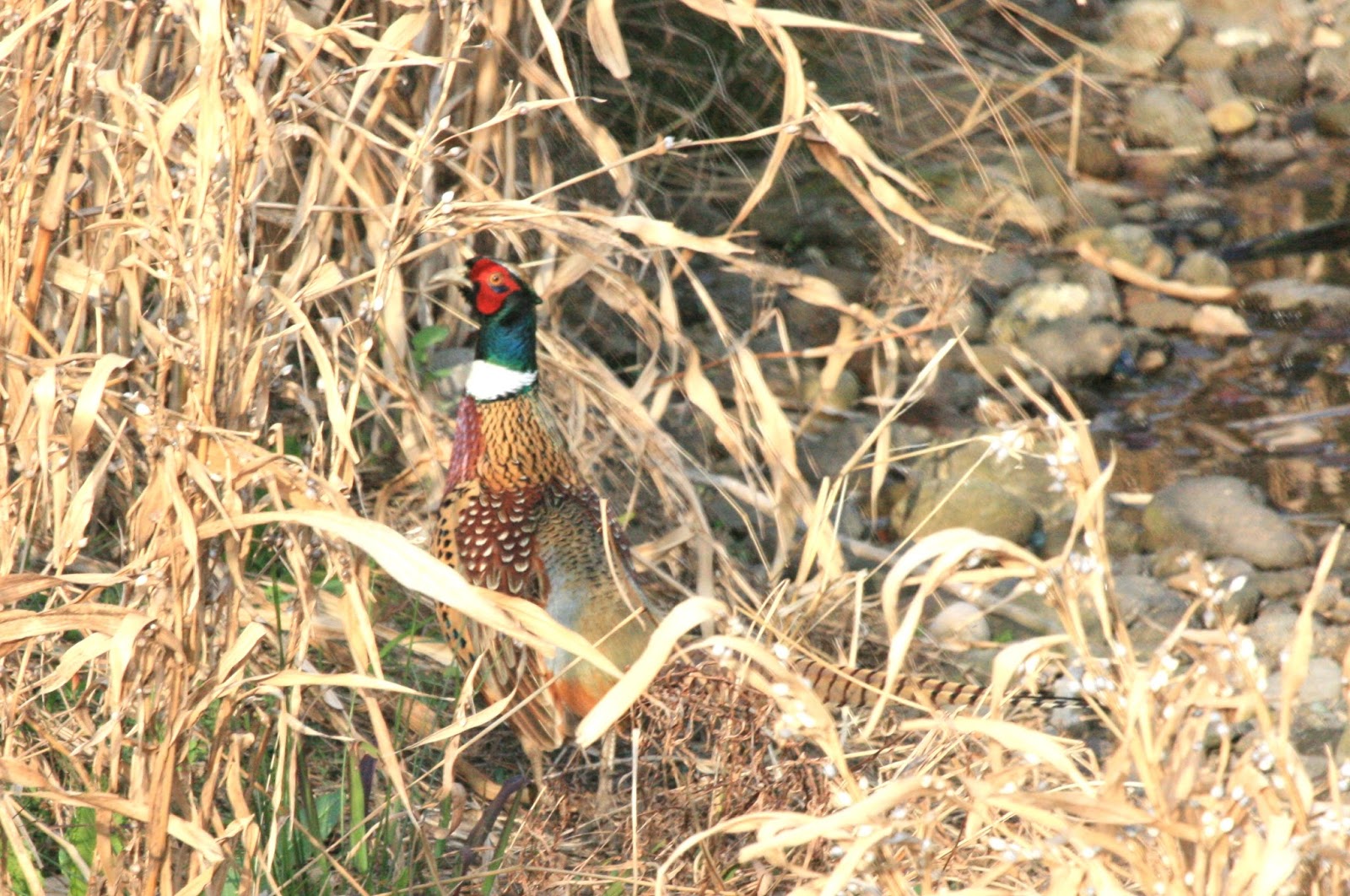
Common Pheasant Phasianus colchicus
Bull-headed Shrike Lanius bucephalus
Large-billed Crow Corvus macrorhynchos
"The Zissou," while hiking Oh-seung-saeng Oreum in Jeju's early days
Jeju island, February 14, 2009
  Stunning summery weather made for a great day of birding in Seogwipo. In the harbour, 14 Great Crested Grebes drifted together offshore, while two Pacific Reef Egrets hunted for fish in tidal pools using a wing-flapping technique. A single Hawfinch and an Osprey were seen near the harbour.
  Along several streams, about 20 Japanese Bush Warblers were seen and heard in the underbrush. A similar number of Pale Thrush bubbled noisily from paths into the undergrowth at my approach. The Striated Heron remains in its corner of a stream, and appeared to be eating insects from a mossy rock. A Common Pheasant, Common Kingfisher, a pair of Bull-headed Shrikes, several Green Sandpipers, and a White-backed Woodpecker were also seen near the stream. A loosely mixed flock of about 40 Eurasian Siskin and Grey-capped Greenfinch moved through the tops of nearby coniferous trees, while a male Daurian Redstart deftly caught insects over the stream at sunset.


(*Note: This is a “historical post.” Whereas I started birding in Korea in 2005, this blog has only been active since early 2012 - these posts are an attempt to consolidate my early birdventures from the various blogs and websites where they reside, largely from the “Archived Bird News“ section of Birds Korea’s excellent website: http://www.birdskorea.org/Birds/Birdnews/BK-BN-Birdnews-archive.shtml. Find more historical posts by clicking on the "Historical posts" tab at the bottom of this post.
  For this post, most of images are lamentably poor-resolution screensaves, as many of the original photo files were lost in the infamous computer crash of 2011.)