Wednesday, August 21, 2013

Birds from a long hot summer pt.II


Chuja Island
Chuja Island
Snipe sp. 
Snipe sp.
Snipe sp.
Little Ringed Plover Charadrius dubius
Streaked Shearwater Calonectris leucomelas
White-backed Woodpecker Dendrocopus leucotos
Far Eastern Skylark Alauda japonica
Far Eastern Cisticola (Zitting Cisticola) Cisticola juncidis
Barn Swallow Hirundo rustica
Eastern Great Tit Parus minor
  Last week saw me re-visit Chuja-do, an island roughly halfway between Jeju and the mainland (and relatively close to Gageo!). I didn't see much from the ferry other than about a dozen Streaked Shearwater. Chuja-do itself was fairly quiet, with a handful of Pacific Swifts seen from atop a hill, and a confusing dead snipe found nearby.
  If I'm honest, I'm pretty awful when it comes to IDing snipes on sight - I rely more on flushing behaviour when it comes to snipes. I took some images of the wing and tail in an attempt to better familiarize myself with the key features to look for, but I fear I'd need a month-long intensive snipe course to fully be comfortable with IDing snipes in the field.
  On a trip out to the west coast I spotted a Far Eastern Cisticola, a Little Ringed Plover, and several Far Eastern Skylarks in a productive patch of farm fields.
  Closer to home, I've recently found a nice quiet spot with at least three confiding White-back Woodpeckers (the official bird of Jeju), and I've been hearing both Lesser and Oriental Cuckoos relatively close to downtown Seogwipo.
  Birds Korea have recently updated their amazing gallery, with quite a few new images and videos. Do yourself a favour and check it out: http://www.birdskorea.org/Gallery/BK-GA-Gallery-Introduction-2013.shtml

Birds from a long hot summer

 
Black Wood Pigeon town
A reliable spot for Greater Spotted Eagles...
Blue Rock Thrush Monticola solitarius
Young Brown-eared Bulbuls Hypsipetes amaurotis waiting for food
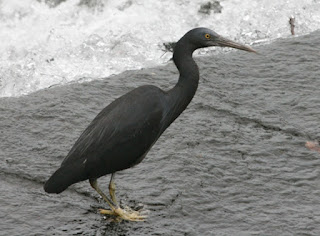
Pacific Reef Egret Egretta sacra
Brown-eared Bulbul Hypsipetes amaurotis parent with food
Me first!
Japanese Bush Warbler Horornis diphone
Eastern Spot-billed Duck Anas zonorhyncha
  It has been record-breakingly hot and humid here on Jeju over the past month. Water levels are at dangerously low levels across the island, and farmers are suffering. As for birds, I've seen a decent array of young birds in different stages of fledging, when I'm not blinded by sweat. Young Pheasants are bigger than pigeons already, and I've been watching juvenile Brown-eared Bulbuls grow at an impressive rate.
  A few weeks ago I spotted two Black Wood Pigeons clacking through a nice-looking stretch of coastal forest, but they've remained elusive since then.
  In my ramblings around my old stomping grounds, I've been disturbed by some of the habitat loss that has occurred over the past two years, more on this soon.

Monday, July 22, 2013

Flashback to Baekryeong Island May 21-24


Awesome beach
Burned-out armoured vehicle on the west coast where we spotted the Slaty-blue Flycatcher
Dr. Moores: he never tires, so do try and keep up
Sunset over a massive reservoir
Bomb shelter
Mind the landmines

Endless 'unbirded' habitat in a prime location

All aboard the Democracy 5!
Lanceolated Warbler Locustella lanceolata
Ruddy-breasted Crake Porzana fusca
Purple Heron Ardea purpurea
Asian Paradise Flycatcher Terpsiphone paradisi
  I fear I've left a pretty patchy record here of my April-May Yellow Sea birding jaunt. Here's a bit from the end of my awesome spring, a trip report written by the inimitable Dr. Nial Moores, a gentleman I had the pleasure of crossing paths with on several islands this spring.
  It was an incredible experience birding such a great bit of underbirded habit, which happens to lie north of the 38th parallel, within sight of the North Korean mainland. As such, it is the most heavily-fortified bit of real estate I've ever seen. Two foreigners bristling with optics and tromping around military bases attracted unwanted attention a few times. But what's a couple of accusations of espionage in the name of spring birding?
  Dr. Moores covers the highlights better than I ever could, so read away! http://www.birdskoreablog.org/?p=9009
  Ah, and here's a pic of a tiny Lanceolated Warbler that I 'cornered' in a small depression. It just sat there, perhaps five feet away, eyeballing me. Great encounter, and one I was lucky enough to get my camera out for, as we had to keep cameras out of sight most of the time. As for the horrible quality of any other bird images I captured, I blame the dusk.

Slow few weeks on Jeju / west coast bikin n birdin


Another road to nowhere
Yongsu Reservoir, west coast
Near Yongsu
Nice-looking Jacana habitat - if it wasn't surrounded by Olle Trails
Seotal Oreum - great for migrants in spring, especially thrushes and buntings
Altreu arifield - relic Kamikaze bunkers, and a great spot for Little Whimbrel and Oriental Pratincoles in spring
Southwest coast, looking east past Sanbangsan
Typical Japanese Paradise Flycatcher habitat
  Pretty quiet around Jeju lately, although I have found three new Japanese Paradise Flycatcher spots, in muggy valleys on the southern slope of Halla Mountain (South Korea's tallest peak) over the past couple of weeks. 
  I went on a ramble round the west coast last weekend in hopes of finding the fabled breeding grounds of rare species known to breed on Jeju in the past, such as Painted Snipe and Pheasant-tailed Jacana. No luck - it's a pretty big haystack to be rambling around.
  I did find some suitable lily ponds, but unfortunately these were much too close to sources of regular disturbance, like fishing spots and the ever-expanding Olle Trails. Looks like I need to gather some more intel...

Sunday, June 23, 2013

A weekend filled with Japanese Paradise Flycatchers

Hopefully this habitat will remain relatively undisturbed
female Black Paradise Flycatcher (Japanese Paradise Flycatcher) Terpsiphone atrocaudata
female Black Paradise Flycatcher (Japanese Paradise Flycatcher) Terpsiphone atrocaudata
male Black Paradise Flycatcher (Japanese Paradise Flycatcher) Terpsiphone atrocaudata
male Black Paradise Flycatcher (Japanese Paradise Flycatcher) Terpsiphone atrocaudata
Common Pheasant Phasianus colchicus chick
Pacific Reef Egret Egretta sacra
Yellow-rumped Flycatcher Ficedula zanthopygia
Bird news from Matt Poll and Mike Balfour
Jeju Island, June 23, 2013
  It is great to be back on Jeju, although a lot of construction/destruction has been going on over the past two years. At a site on Halla’s southern slope formerly home to Fairy Pitta, noisy construction to widen a path for ‘Olle trail’ hikers, coupled with an idiotic speaker blaring music in a once peaceful forest were the only sounds heard today. Nearby, thankfully there remains a quiet corner of habitat still productive for Japanese Paradise Flycatcher, with two males seen squabbling, while a female was quite confiding. It came to within ten feet of us, calmly watching the watchers for several amazing minutes. Also seen in this area were a female Yellow-rumped Flycatcher, a noisy Peregrine Falcon, Yellow-throated Bunting, plentiful Japanese White-eye and Grey-capped Greenfinch, several Lesser Cuckoo, a White Wagtail, Long-tailed Tits, and several comically clumsy Common Pheasant chicks. 
 Back in Seogwipo’s harbour, a stately Pacific Reef Egret stalked prey surprisingly close to a large number of tourists.

Thursday, June 13, 2013

Shorebird flock at Yubu-do

 
Dawn at Yubu Island
  I've been busy settling back in on the singular Jeju Island. It's been quiet as far as birds go, but I did hear a Fairy Pitta (!!) calling outside my window last week, which is promising. Probably on its way to nearby hills. Temporary lack of a vehicle and near-daily rain have so far meant I haven't been able to snoop around some of my secret Pitta/Para-Fly valleys, but I'm hoping that will soon change.
  This video was taken in mid-May at Yubu-do, a surreal little island off Gunsan, while on a mission to see how many critically endangered Spoon-billed Sandpipers were about. We saw several, which is impressive when you consider that there are perhaps only 150 individuals left worldwide. This year's Birdathon was especially meant to help raise money and awareness for Spoonies. http://www.birdskorea.org/Support_us/BK-SU-Birdathon-2013.shtml 
  I have a large backlog of photos and reports from my amazing spring in the Yellow Sea, I'm hoping to properly sort through it and post it up soon.