Wednesday, June 18, 2014

Morgan Arboretum, Montreal, June 18, 2014


White Admiral Limenitis arthemis
Northern Cardinal Cardinalis cardinalis
White-tailed Deer Odocoileus virginianus
Mystery rump (terrible picture, I know)
Turkey Vulture Cathartes aura
Common Yellowthroat Geothlypis trichas


  A quick jaunt through the Morgan Arboretum with Dan turned into a grim death march, thanks to the clouds of voracious and merciless mosquitoes. When we weren’t waving our swollen hands around like idiots in a vain effort to fend off the mozzies, we managed to get decent looks at a few cracking summer birds. In addition to the birds listed below, we heard an interesting bird call coming from the dense treetop foliage. To my ears, it most sounded like a (Eurasian) Grey Nightjar, only slower (listen to the ‘call’, second from the top):  http://www.xeno-canto.org/explore?query=grey+nightjar What sounds like this in North America? Any input is most welcome. 
  Bird(s) of the day - Matt: Common Yellowthroat, Dan: Indigo Bunting.

Turkey Vulture – 1
Chimney Swift - 5
Ruby-throated Hummingbird – 2 briefly but well seen
Hairy Woodpecker - 2
Eastern Wood-Pewee – 2 heard
Red-eyed Vireo - 1
American Crow - 4
Black-capped Chickadee – 10+
White-breasted Nuthatch - 2
American Robin – 4+
Yellow Warbler – 2 heard, perhaps
Common Yellowthroat – 1 gorgeous and confiding male checked us out closely
Indigo Bunting – 1 cracking male calling from a treetop
Northern Cardinal - 2
Chipping Sparrow – 12+
Song Sparrow - 7
Red-winged Blackbird – 6+
Common Grackle - 3
American Goldfinch – 10+

*Update:
The butterfly was a White Admiral, and the strange nightjar-like call belonged in fact to an Eastern Chipmunk. Thanks BPQers for the input.

Thursday, June 12, 2014

Montreal Merlin, June 10, 2014

 
Merlin Falco columbarius
  This Snowy Owl has migrated back to Montreal for a bit, and it's great to be home! I went for a wander around Westmount the other day, and spotted a cracking Merlin near the Oratory. Is it common to see Merlins in Montreal? No clue, ha ha, I've been in Korea for way too long.

Monday, June 2, 2014

Seogwipo, Jeju, June 1, 2014


Fairy Pitta Pitta nympha
Black Paradise Flycatcher (Japanese Paradise Flycatcher) Terpsiphone atrocaudata
Long-tailed Tit Aegithalos caudatus
Striated Heron Butorides striata
juvenile Varied Tit Sittiparus varius
juvenile Varied Tit Sittiparus varius

  At a relatively undisturbed (yet) spot near town, three individual Fairy Pittas (or maybe two pairs) called from the treetops, mostly unseen. One of them had a strange three-note call, instead of the more familiar two-note call. Listen here:
https://soundcloud.com/mat-poll/fairy-pitta-triple-call

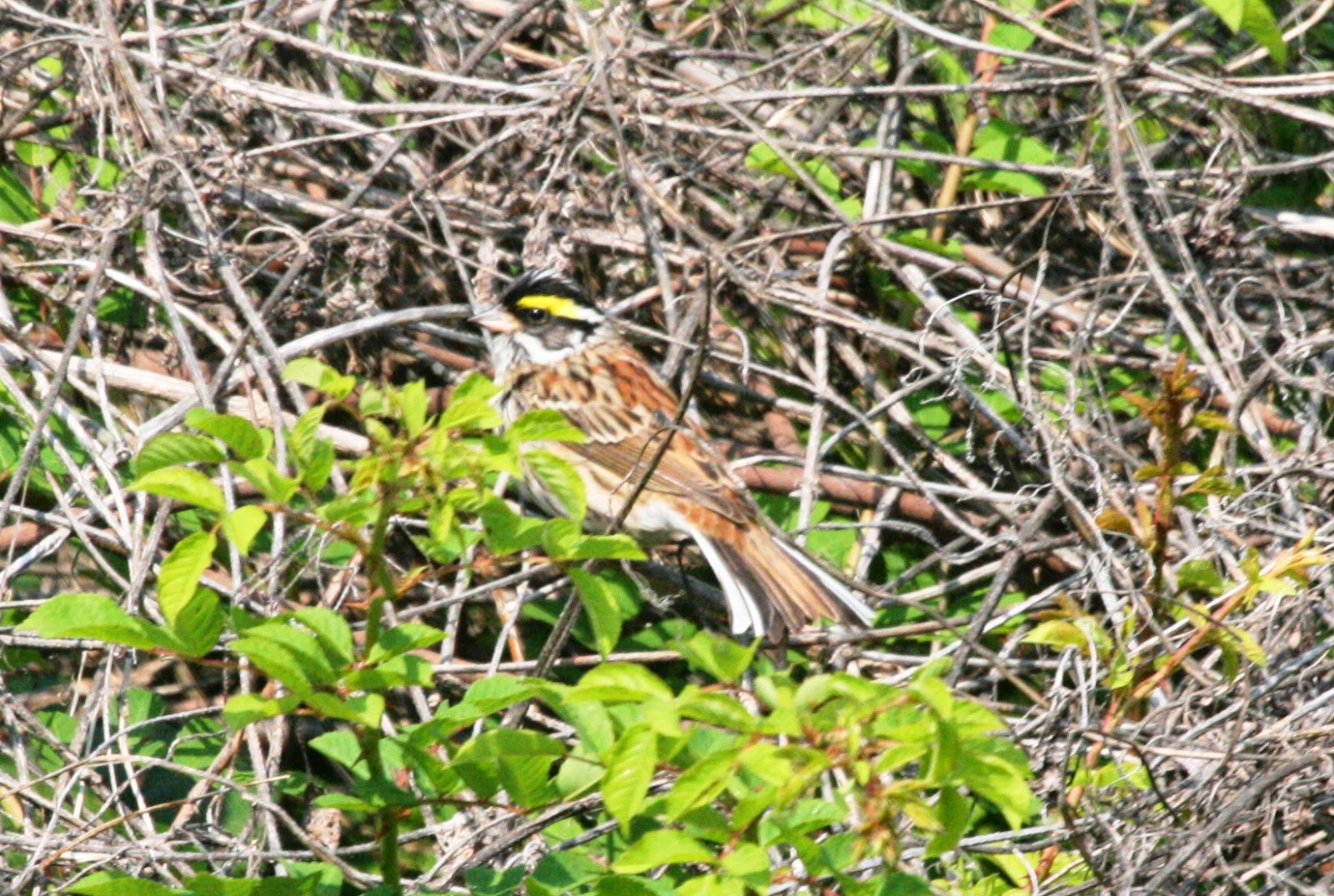
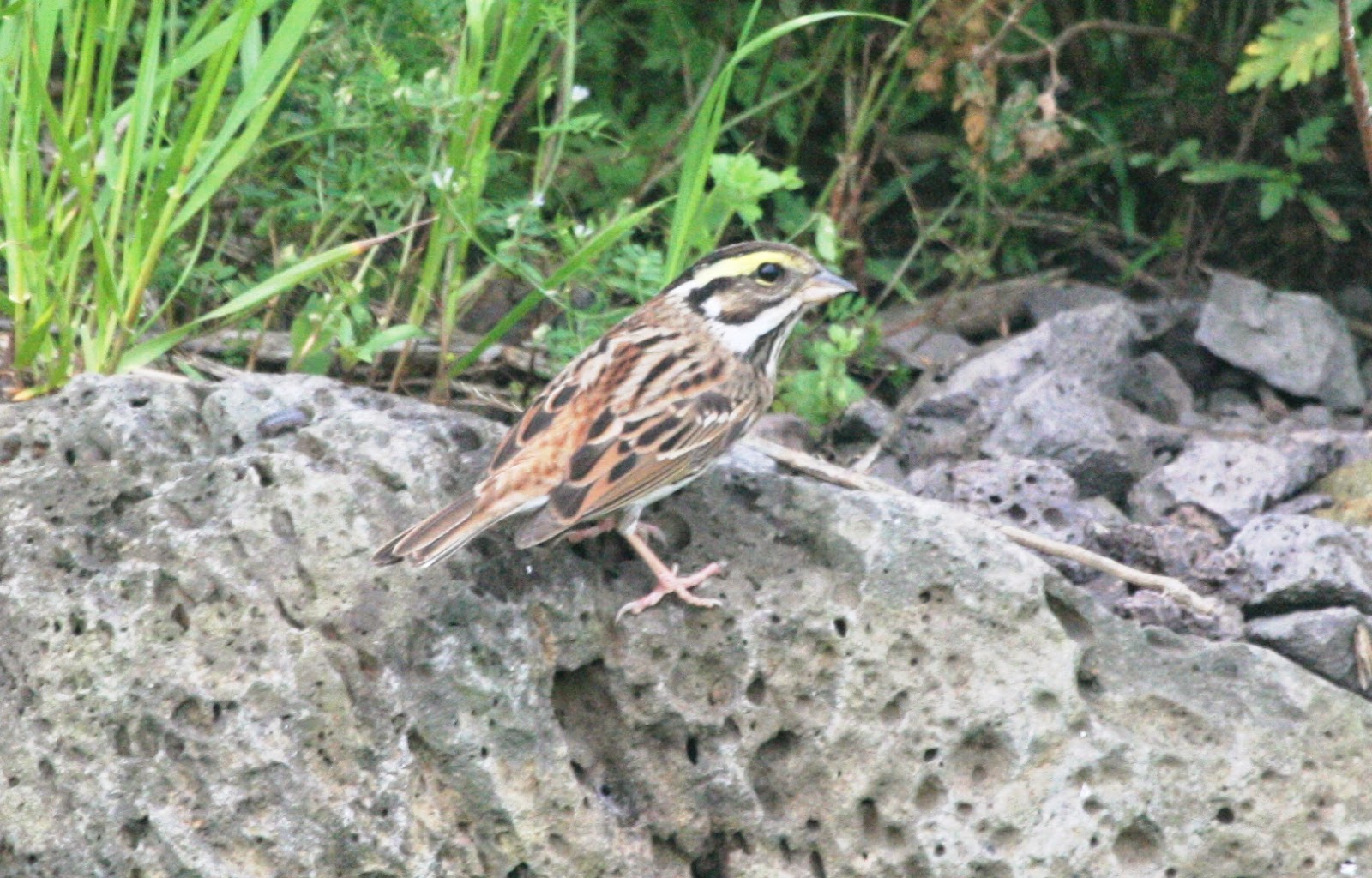
  Two Northern Boobook called from nearby, but remained frustratingly out of sight. It was hard to hear other birds at times over the manic refrain of the Common and Lesser Cuckoos. A pair each of secretive Yellow-rumped Flycatcher and Yellow-throated Bunting fed busily and appeared to be bringing food back to nests. Great, Long-tailed, and Varied Tits (including some interesting grey-bellied juveniles) were also seen, as well as a White-backed Woodpecker. At least three pairs of Japanese Paradise Flycatchers were active and vocal along the trail, giving some good views. Elsewhere around Seogwipo, I’ve found a further four pairs on different stream beds.
  Back in town, a Striated Heron (perhaps the same individual that has been overwintering in this park) paced the bank of a stream in a park. Last week in the same park I saw a pair of Asian Brown Flycatchers that were acting like there was maybe a nest nearby.
  Last night I heard a Fairy Pitta calling from the stream behind my apartment at about 2 a.m. It was heading north towards Halla Mountain. I heard a similar late-night phenomenon on June 6th of last year – is this stream a nocturnal highway for fresh-in Fairy Pittas?

Tuesday, May 6, 2014

Hado-ri, May 7, 2014

Pied Avocet Recurvirostra avosetta
  At Hado, a gorgeous Pied Avocet fed in the company of three Black-winged Stilts, and 33 Black-tailed Godwits. I got long, if distant looks as it fed by swimming and upending repeatedly. Also at Hado, and nearby Ojo-ri, were single-digit numbers of Marsh, Common, and Wood Sandpiper, Common Greenshank, Common Redshank and Falcated Duck.

  Several Rufous-tailed Robins have been heard in Seogwipo over the past few days, and several Tristram’s Buntings and a male Mugimaki Flycatcher were seen in local parks.

Sunday, May 4, 2014

Jeju, April 26-May 2, 2014

Yellow-browed Warbler Phylloscopus inornatus
female Black-faced Bunting Emberiza spodocephala
Narcissus Flycatcher Ficedula narcissina
juvenile White Wagtail Motacilla alba being fed
Common Rosefinch Carpodacus erythrinus
Asian Stubtail Urosphena squameiceps
Tristram's Bunting Emberiza tristrami
juvenile White Wagtail Motacilla alba
male Yellow-browed Bunting Emberiza chrysophrys
female Yellow-browed Bunting Emberiza chrysophrys
  It has been a dynamic week on Jeju, with 85 species of birds observed. The mostly quiet week was punctuated by several busy and very birdy days midweek, right after heavy rain and SSW winds.
  On April 26th, I visited Mara-do and Jeju’s west coast. Mara-do was extremely quiet, with most notable being several Richard’s Pipits, Grey and Brown-headed Thrushes, and Narcissus Flycatchers. At least a dozen Streaked Shearwaters were seen from the ferry (which seemed relatively empty for a weekend).
  Farmer’s fields on nearby Jeju were buzzing with singing Far Eastern Skylarks, Far Eastern Cisticolas, Stejneger’s Stonechats, and several noisy but frustratingly unseen Japanese Quail.
  At a quiet Yongsu Reservoir, a pair of Garganeys and a Chinese Pond Heron were notable. Pairs of White-cheeked Starlings were seen building nests in the supports for large highway signs at several west coast locations. A single Chestnut-cheeked Starling was following one pair around. Further down the road, the encouraging sight of a Red-billed Starling seen with nesting materials.
  On April 29th, I was surprised when I opened to the door to my fifth floor apartment and heard a familiar call coming from the stairwell above. When I got upstairs, I saw a shaken Asian Stubtail that was trying to free itself from the building by bashing repeatedly into the closed window. I opened the window wide and left it alone, and happily it was gone 20 minutes later. One year ago on Gageo I had to rescue an Asian Stubtail from a small abandoned chicken coop, and several other birders have relayed their similar ‘Stubtail in distress’ stories to me. Why do Asian Stubtails seem to get themselves into these sorts of predicaments?
  I visited Jeju’s south coast around Jungmun on April 30th, looking for some evidence of migration after the rain. I tried out a new spot on a hunch and found a small oasis filled with flycatchers and warblers. On the quiet stream I found a pair of Blue-and-white Flycatchers, a shy male Yellow-rumped Flycatcher, several Asian Brown Flycatchers, and Yellow-browed Warblers. A few active Black-faced Buntings were also seen, with two females feeding in the open, as a male sang from a nearby treetop. Also seen were two Striated Herons in crisp breeding plumage, and a presumed Swinhoe's Snipe.
  Encouraged by the rise in bird activity, I returned to these new spots on the first of May and one of the first birds I encountered was a Common Rosefinch. In a tree teeming nervously with flycatchers, white-eyes, and warblers, I saw a drab bird notable for its lack of movement. It was clearly a finch, with a strongly notched tail, (very) heavy bill, and streaked underparts. The overall drabness, heavy bill, light 'string-of-pearl' markings on the wings, and even the faint eye-ring were noted in the field, before it headed north, one tree at a time. I also heard my first Oriental Reed Warbler of the year nearby.
  Nearby, I watched a juvenile leucopsis White Wagtail being fed and watched over by an attentive pair of adults (do they breed earlier on Jeju than elsewhere?). On the 30th, the juvenile didn't fly, instead choosing to amble around and stretch its wings. Today it made several short, ungraceful flight-hops. A Eurasian Magpie that watched the young bird too closely was sent off by one of the adult birds, in a dramatic attack.
  In a nearby park, I quickly picked out at least six Yellow-browed Buntings and two Little Buntings mixed in with about a dozen Black-faced Buntings. A dozen Cattle Egrets paced nervously in the ponds. This park was very 'unbirdy' for the first several years of its existence, probably due to the intensive and gaudy maintenance - bushes and weeds were whacked down as soon as they grew past the ankles, and the grass was kept golf-course short. This year, however, for whatever reasons, the vegetation in the park has been allowed to grow more naturally and unchecked, and probably as a direct result, the feeling this year is drastically different. This park now feels like a functioning system filled with predators, prey, viable and varied habitat, and an impressive range of flora and fauna - as opposed to a sterile and unchallenging place to have a picnic. Inevitably though, the site is flanked on two sides by new and massive construction sites. The development on Jeju over the past few years has been both staggering and thoughtless.
  On May 2nd, the two spots that were buzzing with birds were ghostly quiet. At dawn on a tourist-ridden islet in Seogwipo’s harbour, best were an Asian Stubtail, Narcissus Flycatcher, and two Tristram’s Buntings. In a field near Jungmun, I spotted two Chestnut-eared Buntings.

Sunday, April 13, 2014

Jeju: Mara-do April 11, Seogwipo April 12-23, 2014


Blue-and-white Flycatcher Cyanoptila cyanomelana
Narcissus Flycatcher Ficedula narcissina
Grey Thrush (Japanese Thrush) Turdus cardis
'Mandarin Muscovy'
Jeju: Mara-do April 11, Seogwipo, April 12-23

Mara-do
1.    Black-tailed Gull Larus crassirostris
2.    Ancient Murrelet Synthliboramphus antiquus; two from the ferry
3.    Pacific Swift Apus Pacificus
4.    Eurasian Magpie Pica pica
5.    Great Tit Parus major
6.    Far Eastern Skylark Alauda japonica; several remain
7.    Barn Swallow Hirundo Rustica
8.    Japanese Bush Warbler Horornis diphone
9.    Japanese White-eye Zosterops japonicus
10.   White’s Thrush Zoothera aurea; one remains in the woods
11.   Grey Thush Turdus cardis; two males in the woods, one female on the rocks
12.   Pale Thrush Turdus pallidus
13.   Brown-headed Thrush Turdus chrysolaus; three in the woods
14.   Red-flanked Bluetail Tarsiger cyanurus; still a dozen females
15.   Stejneger’s Stonechat Saxicola stejnegeri
16.   Blue Rock Thrush Monticola solitarius
17.   Eurasian Tree Sparrow Passer montanus
18.   White Wagtail Motacilla alba
19.   Olive-backed Pipit Anthus hodgsoni; two on the rocks
20.   Grey-capped Greenfinch Chloris sinica
21.   Yellow-throated Bunting Emberiza elegans

Seogwipo, April 12-13
  Seogwipo’s parks are buzzing with flycatchers! Cracking male Narcissus Flycatchers were spotted in two riverside parks, with six seen in total. Blue-and-white (5), Asian Brown (3), and Dark-sided (1) Flycatchers were also seen gorging themselves on insects. Also notable in these parks was a freshly-marked Eastern Crowned Warbler, and a Striated Heron on a familiar patch of stream (where I’ve seen Striated Herons overwintering in the past, but not this past winter). A presumably escaped Muscovy Duck was also seen here, with a head and bill structure strongly recalling a Mandarin Duck.
  In my neighbourhood, small groups of Ashy Minivets have been heard twice more in the past week, with a single bird spotted circling aimlessly around the area for several days.

Tuesday, April 8, 2014

Mara-do and southwest coast, Jeju, April 6

Red-flanked Bluetail Bluetail Tarsiger cyanurus - they were EVERYWHERE on Sunday
Mara-do
1.     Streaked Shearwater Calonectris leucomelas; one seen from         the ferry
2.     Bar-tailed Godwit Limosa lapponica; two groups of roughly 10 seen heading towards Jeju
3.     Red-necked Phalarope Phalaropus fulicarius; 11 from the ferry between Mara and Gapa
4.     Black-tailed Gull Larus crassirostris
5.     Pacific Swift Apus Pacificus
6.     Eurasian Magpie Pica pica
7.     Great Tit Parus major
8.     Far Eastern Skylark Alauda japonica
9.     Barn Swallow Hirundo Rustica
10.   Japanese Bush Warbler Horornis diphone
11.   Japanese White-eye Zosterops japonicus
12.   Pale Thrush Turdus pallidus
13.   Brown-headed Thrush Turdus chrysolaus; several skulking in the woods
14.   Dusky Thrush Turdus eunomus
15.   Red-flanked Bluetail Tarsiger cyanurus; at least 20, mostly females
16.   Stejneger’s Stonechat Saxicola stejnegeri; numbers up to almost a dozen
17.   Blue Rock Thrush Monticola solitarius
18.   White Wagtail Motacilla alba
19.   Buff-bellied Pipit Anthus rubescens
20.   Brambling Fringilla montifringilla; the most numerous migrant on Mara, over 40 seen
21.   Grey-capped Greenfinch Chloris sinica
22.   Yellow-throated Bunting Emberiza elegans

  Back on southwestern Jeju, I encountered groups of 12-20 Red-flanked Bluetails at 4 different patches of coastal woods. There were more males in the mix compared to Mara, and they were all feeding on sunny paths at forest edges. Also notable on ‘mainland Jeju', one Japanese Quail, and a group of shorebirds made up of nine Kentish Plover, two Dunlin, and one Red-necked Stint. Nearby, another Brown-headed Thrush was heard, and a White’s Thrush and personata Black-faced Bunting were seen.
On Saturday April 5th, in spite of a full day of birding in the hills, the most notable birds were encountered before I got out of bed - two groups of Ashy Minivets flew past my window during the early morning, heading towards Halla Mountain.

Tuesday, April 1, 2014

Mara-do, Jeju, March 30, 2014

Mara-do
Barn Swallow Hirundo rustica
Rough seas
On a blustery day filled with low scudding clouds and rough seas, there was some interesting movement and turnover on Mara-do. Although most birds were perhaps sheltering from the winds, and despite the fact that I only had an hour on the island, there were some birds about. The feeling was decidedly different from the previous week, with winter birds clearing out, and more migrants and breeders moving through.
  Notable on Jeju’s nearby mainland were several Garganey mixed in with Spot-billed Duck and Eurasian Teal. Also, Barn Swallows have returned in force.
1.     Black-crowned Night Heron Nycticorax nycticorax; presumably the same three individuals from last weekend
2.     Peregrine Falcon Falco peregrinus; one prowling the rocks where tired migrants often shelter
3.     Eurasian Woodcock Scolopax rusticola; one flushed silently in front of me, flying straight and low – noticeably larger than snipes, with large ‘kestrel-colored’ rump very evident
4.     Black-tailed Gull Larus crassirostris
5.     Pacific Swift Apus Pacificus; at least 30 engaged in aerial ballet low over the island
6.     Eurasian Magpie Pica pica
7.     Great Tit Parus major
8.     Far Eastern Skylark Alauda japonica
9.     Barn Swallow Hirundo Rustica
10.   Japanese Bush Warbler Horornis diphone
11.   Japanese White-eye Zosterops japonicus
12.   White-cheeked Starling Spodiopsar cineraceus
13.   White’s Thrush Zoothera Aurea; one spotted in the woods with a Pale Thrush
14.   Pale Thrush Turdus pallidus
15.   Stejneger’s Stonechat Saxicola stejnegeri; one in a grassy field
16.   Daurian Redstart Phoenicurus auroreus 
17.   White Wagtail Motacilla alba
18.   Hawfinch Coccothraustes Coccothraustes; one seen on the rocks
19.   Grey-capped Greenfinch Chloris sinica
20.   Yellow-throated Bunting Emberiza elegans

Wednesday, March 26, 2014

Jeju, March 22-23, 2014

Scanning ducks at Seongsan
Grey-backed Thrush Turdus hortulorum 
Meadow Bunting Emberiza cioides at Hado (very dark facial markings!)
Meadow Bunting Emberiza cioides at Mara-do (facial marking almost black...ciopsis?!)
Common Redshank Tringa totanus
Saunders's Gull Chroicocephalus saundersi
Frustrating uselessness at Hado
Mara-do, Jeju, March 22, 2014
  Largely the same feeling today on Mara when compared with last Saturday. The Oriental Plovers were missed, and a few new birds were noted, like Black-crowned Night Heron, Hoopoe, Eurasian Wren, Chinese Grosbeak and Eurasian Siskin. Distressingly, a large orange cat was seen prowling in the woods, the first time I’ve observed this. One can only imagine how many exhausted migrants this cat will kill in the coming weeks and months.


1. Great Crested Grebe Podiceps cristatus
2. Black-crowned Night Heron Nycticorax nycticorax; three seen circling before settling in the tallest trees on the island
3. Peregrine Falcon Falco peregrinus
4. Black-tailed Gull Larus crassirostris
5. Ancient Murrelet Synthliboramphus antiquus
6. Hoopoe Upupa epops
7. Eurasian Magpie Pica pica
8. Great Tit Parus major
9. Far Eastern Skylark Alauda japonica
10. Barn Swallow Hirundo Rustica
11. Japanese Bush Warbler Horornis diphone
12. Japanese White-eye Zosterops japonicus
13. Eurasian Wren Troglodytes troglodytes; one briefly seen at the edge of the woods
14. Dusky Thrush Turdus eunomus
15. Daurian Redstart Phoenicurus auroreus
16. Blue Rock Thrush Monticola solitarius
17. Eurasian Tree Sparrow Passer montanus; 30+ in the village
18. White Wagtail Motacilla alba
19. Chinese Grosbeak Eophona migratoria; a flock of 12+ was restlessly roaming the island
20. Grey-capped Greenfinch Chloris sinica
21. Eurasian Siskin Carduelis spinus; one heard
22. Meadow Bunting Emberiza cioides; one individual with mostly black (as opposed to brown) head pattern – darkest I’ve seen on Jeju...
23. Yellow-throated Bunting Emberiza elegans; 20+ in the woods

Jeju north coast, March 23 (with Mike Balfour)

  Sunday saw calm and warm weather after a windy and smoggy week on Jeju. Definite signs of spring movement noted, with some birds seemingly early. We saw a total of 61 species today, at parks in Jeju City, at Hado, and Seongsan. In Jeju City, a crisp Grey-backed Thrush was a real treat to watch as it perched in a tree. Three Chinese Grosbeaks and plentiful Pale Thrush were also noted in this park.
  Near Seongsan, we stopped to look at gulls, and were surprised to see a Saunders’s Gull in summer plumage gracefully wheeling low to the water (a personal Jeju first). Very high overhead, three Cinereous Vultures circled on a thermal - probably Jeju’s strangely resident vultures.

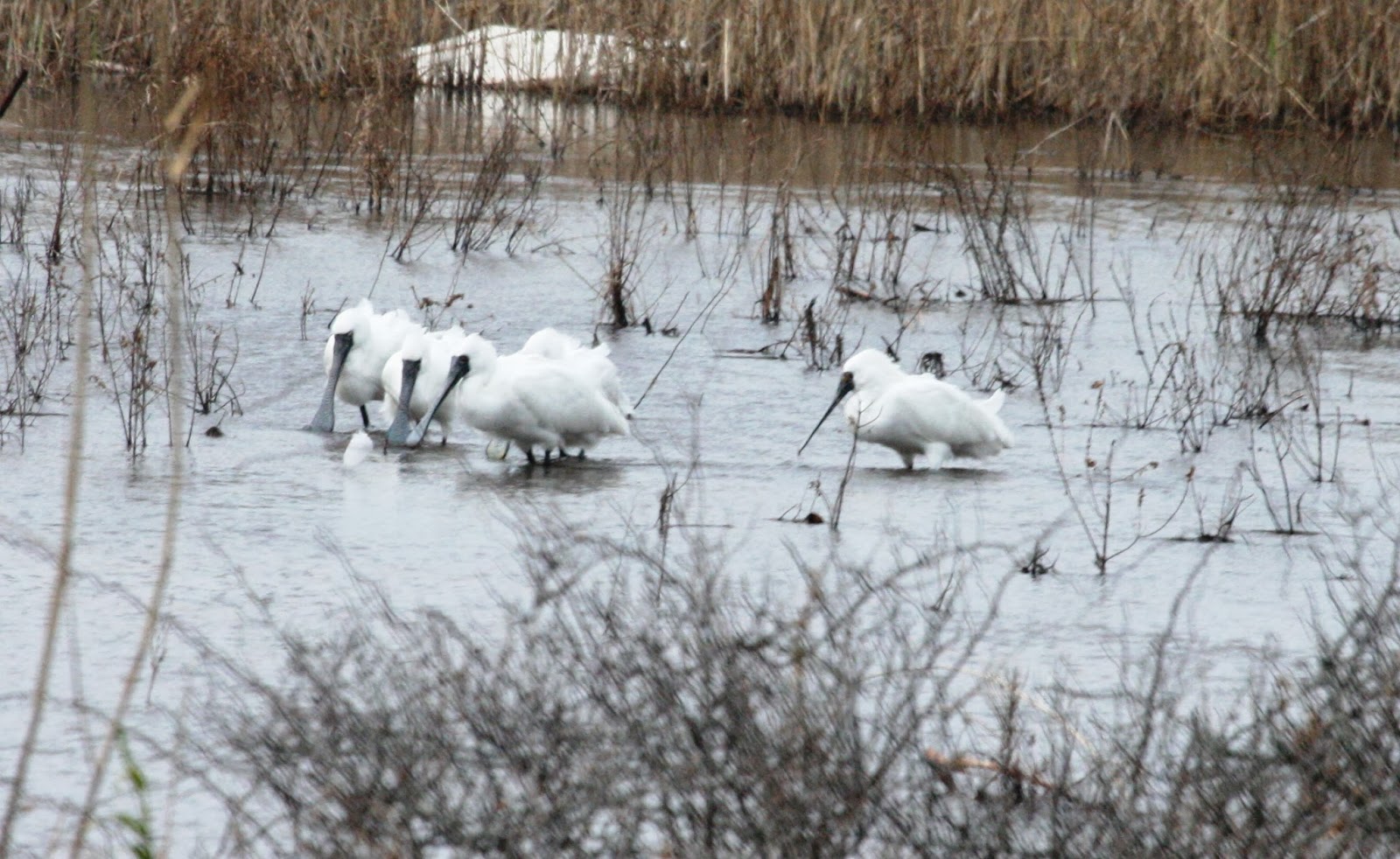
  At Hado, we were glad to see seemingly healthy numbers and diversity of waterfowl, in spite of disruptive spraying and other showy/dubious AI (bird flu) countermeasures. The Black-faced Spoonbills that regularly overwinter at Hado, however, have stayed away, and some can be found near Seongsan at a far less ideal site located next to a new walking trail. A new viewing platform has been built much closer to the reservoir at Hado, and worryingly, a picnic gazebo – right at the water’s edge.
  Also at Hado, two more relatively dark-faced Meadow Buntings were seen. I’ve seen plenty of Meadow Buntings on Jeju over the years, but never with such dark facial markings. They also seemed to make a more ‘tingy’ insect-like call than I’m used to. How closely related to Japanese Ciopsis Meadow Buntings are Jeju’s Meadow Buntings? Read Dr. Nial Moores’ excellent ID notes here:http://www.birdskorea.org/Birds/Identification/ID_Notes/BK-ID-Meadow-Bunting.shtml

Monday, March 17, 2014

Mara-do, Jeju, March 15, 2014

Mara Island - the furthest south you are going to get in South Korea without swimming
Oriental Plover Charadrius veredus
Streaked Shearwater Calonectris leucomelas
1.       Arctic Loon Gavia arctica; 20+ near Sagye harbour
2.       Streaked Shearwater Calonectris leucomelas; five from the ferry (early?)
3.       Great Crested Grebe Podiceps cristatus; 90+ near the ferry harbour at Sagye
4.       Oriental Plover Charadrius veredus; two confiding males in partial breeding plumage
5.       Black-tailed Gull Larus crassirostris
6.       Ancient Murrelet Synthliboramphus antiquus; five from the ferry, two in breeding plumage
7.       Eurasian Magpie Pica pica; three individuals around the village
8.       Far Eastern Skylark Alauda japonica; 15 or more resting in the short grass, ‘chirruping’ quietly, unlike their counterparts nearby on Jeju proper, that were in full song in the fields
9.       Barn Swallow Hirundo Rustica; only one seen over the island
10.   Japanese Bush Warbler Horornis diphone
11.   Japanese White-eye Zosterops japonicus; 10+ in the small woods at the island’s centre
12.   Naumann’s Thrush Turdus naumanni
13.   Dusky Thrush Turdus eunomus
14.   Daurian Redstart Phoenicurus auroreus
15.   Blue Rock Thrush Monticola solitarius
16.   White Wagtail Motacilla alba; two leucopsis
17.   Richard’s Pipit Anthus richardi
18.   Grey-capped Greenfinch Chloris sinica; eight in the woods

+Belated Seogwipo Bird News
At ‘Redpoll Hill’, a brief sighting of a Yellow-browed Warbler on March 4th was followed by a much better listen/look at three individuals on March 13th. On the same day, a single Goldcrest was seen (my first Goldcrest on Jeju in 3+ years), and several Tristram’s Bunting still. Also, a possible Black Wood Pigeon – a large dark pigeon clacked its wings loudly as it took off, then flew strongly through the canopy. On March 14th, I spotted my first Barn Swallows of the year, just east of town. I watched 30+ swooping over an artificial pond for an enjoyable 20 minutes.

Tuesday, March 4, 2014

Other bits and bobs from the past couple of weeks

Blue Rock Thrush Monticola solitarius
Yellow-throated Bunting Emberiza elegans
Grey-capped Greenfinch Chloris sinica
Chinese Grosbeak Eophona migratoria
Arctic Loon (Black-throated Loon) Gavia arctica
Black-faced Spoonbill Platalea minor
  I've been roaming the hills and coasts of late in an effort to find new habitat. When I lived on Geoje it took me almost a year before I found some great spots, and I'm kicking myself for that. Seogwipo has some decent areas of habitat, but I've found them to be less birdy than they've been in the past. This may be down to increased disturbance due to tourism. Local officials have been chasing the almighty Chinese tourism dollar lately, with developers putting up anything they can, anywhere they can. I constantly find myself driving around saying 'THAT wasn't there two years ago,' about a never-ending series of cafes, hotels, and the construction sites that spawned them. So I'll search higher in the hills, and further down the coast, in the hopes there's some undisturbed habitat left somewhere.