|
| Suncheon Bay |
 |
| Creeping around in the hills of Dolsan Island |
 |
| Pechora Pipt Anthus gustavi |
 |
| juvenile White-winged Tern Chlidonias leucopterus |
 |
| Broad-billed Sandpiper Limicola falcinellus |
 |
| Black-capped Kingfisher Halcyon pileata |
 |
| Pied Harrier Circus melanoleucos |
 |
| Long-tailed Tit Aegithalos caudatus |
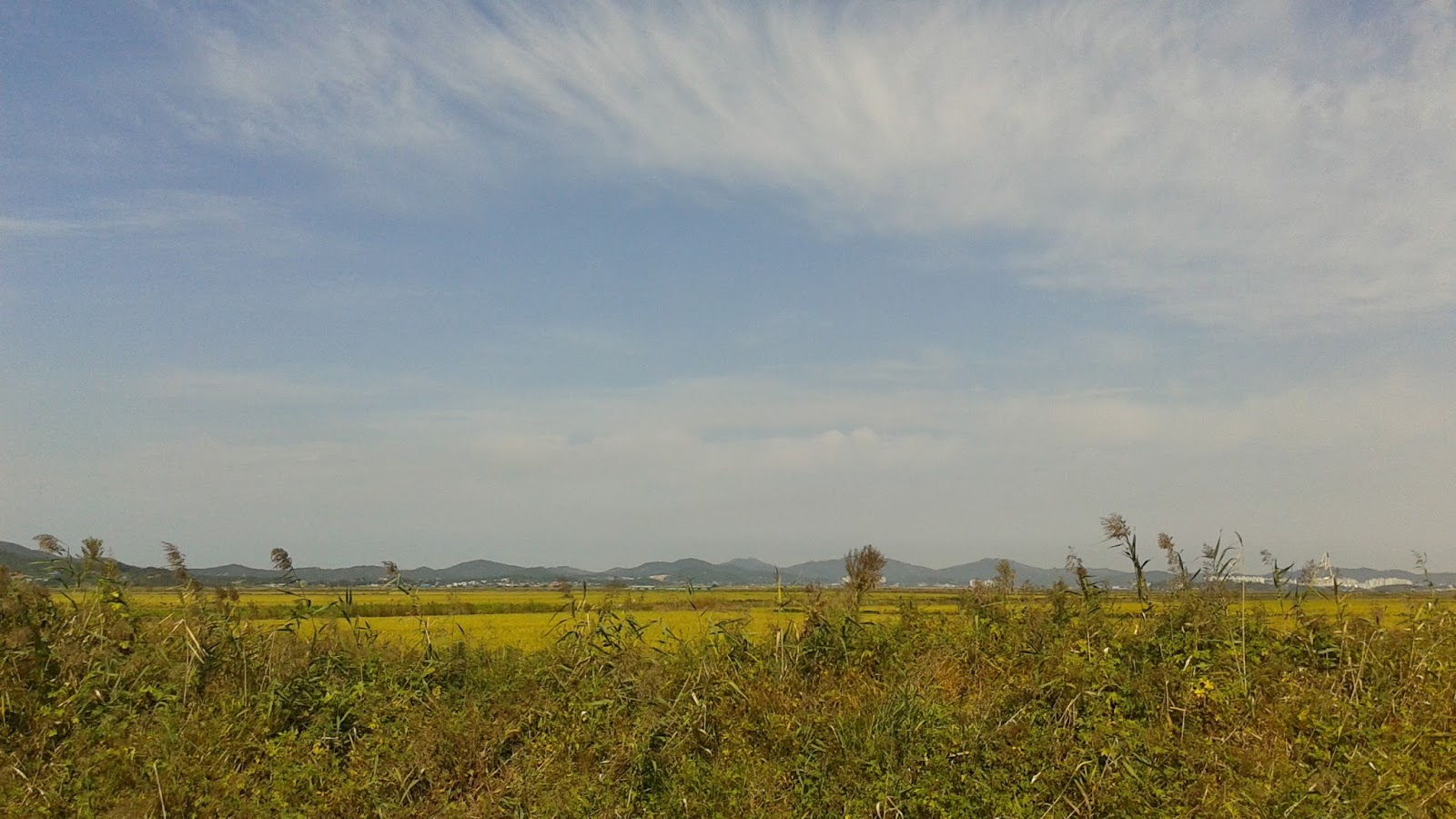
It has been incredible to observe the gradual
seasonal changes occurring at Suncheon Bay, a stunning and peaceful place at
dawn. Unfortunately, at other times it is not so
peaceful, with a wide range of disturbances spoiling the tranquility of the
habitat used by large numbers of resident birds as well as migrating
shorebirds. Picnickers using pedal cars to access quiet areas
of the bay often leave behind heaps of garbage, much of which ends up blowing
into the bay. On some days, a large (almost four metres long) and
noisy remote-controlled crop-dusting helicopter was seen over the rice fields. It raced noisily up and down the fields adjacent to the bay, repeatedly
putting up flocks of egrets and shorebirds. Additionally,
large noisemakers on five-minute timers that produce shotgun-like booms where rice
is being harvested have been heard for several weeks in Suncheon’s otherwise
sedate rice fields.
The
endless disruptive construction work being done on the seawall finally seems to
be tapering down. Unfortunately, the Eurasian Bittern seen on July 10th has
not been seen since the heavy construction equipment moved into 'its' area shortly
after that sighting. I sincerely hope this area adjacent to the eco-park
stays closed to the general public. Thanks
to the crowds, the well-touristed main park is already fairly unwelcoming to
migrating birds. The agricultural areas around it are so vital to
migrants, it would be calamitous if they were to be opened up to organized
tourism, or developed further.
On
August 8th, several Raccoon Dog pups were spotted near the bay,
as well as 50-60 Cattle Egrets. August
26th saw a flyover male Black-winged Stilt, a Black-capped Kingfisher, and a Sand Martin mixed in with at least a hundred
Barn Swallows. Notable at the bay on September 4th were
two young ‘tigery’ Yellow Bitterns, and a reduction in both Cattle Egret
numbers and colouration, with only seven mostly white individuals seen in the rice
fields. Several Far Eastern Curlews were observed cleverly
feeding on crabs on a small inland path. Another Sand Martin was seen with a
70-strong group of hirundines perched on power lines, mostly Barn Swallows with
six Red-rumped mixed in. Two days later near the bay, observations included
an Asian Brown Flycatcher, and another clumsy young Yellow Bittern.
The
following week, on the 10th, new arrivals at the bay included low
double-digit numbers of Red-necked Stint, Common Snipe, White, Grey, and Eastern Yellow Wagtail, as well as a Eurasian Hoopoe. Shorebird
numbers continued to gradually swell. Only
one Cattle Egret remained in a field where dozens had recently fed. The
best bird of the day was also the first – an extremely early Short-eared Owl
flushed from a ditch among rice fields just before dawn. Its
underparts and side profile were seen well through binoculars as it flushed and
flew low along the ditch. A pleasant surprise later in the day was the sight
of at least 200 Barn Swallows sagging down power lines right outside my window,
with several of them showing a pinkish wash to their underparts.
On
September 15th, dawn at the bay saw a female Black-winged Stilt, two
Yellow Bitterns, still decent numbers of Eastern Yellow Wagtail, with Common Snipe
numbers down to five. The day’s highlight was a juvenile White-winged
Tern flying low just above the rice fields, deftly catching insects on the
wing, and cavorting with Barn Swallows at times. This
was my first time observing the species, and it was a real treat! No
renewed sign of the Short-eared Owl on the 17th, and the White-winged Tern
appeared to have moved on. The
Black-winged Stilt, Red-necked Stints, Eastern Yellow Wagtails, and several Common
Snipes remain, while several Far Eastern Cisticolas were seen and heard calling
from high overhead. Three days later, a confiding Broad-billed
Sandpiper was seen. It was seen again on the 23rd, along
with an apparent Pied Harrier and Black-winged Stilt still, and a personal
first Stejneger’s Stonechat of the fall.
The
morning of the 24th had a notably large congregation of Little and
Intermediate Egrets spotted on a small waterway near the bay, totalling perhaps
70 birds. At least 250 Barn Swallows and several Red-rumped
Swallows were seen intensely feeding where reeds give way to mudflats,
presumably preparing for their long flight south. An Arctic Warbler seemed out
of place on the seawall, flitting nervously through the scrub.
The
morning also produced a memorable encounter with a bird I had seen only once
previously. On the way out of the rice fields, a pipit flushed
from the path in front of my motorcycle. I
quickly shut down, coasted to a stop, and hunched behind the handlebars. To
my delight, the bird, a cracking Pechora Pipit, walked along the ditch straight
towards me, and I was able to observe it from very close range for several
minutes. An incredible birding moment.
Not
much different on the 26th, with best being a Eurasian
Wryneck. Shorebirds were represented by at least one hundred
Black-tailed Godwits, and smaller numbers of Common Greenshank, Spotted
Redshank, Red-necked Stint, Eurasian and Far Eastern Curlew, Whimbrel, Common
Snipe, Terek Sandpiper, Pacific Golden Plover, Dunlin, Marsh Sandpiper, and the
lingering Black-winged Stilt.
Away
from the Bay, a weekend trip to Dolsan-do on August 29-30th had
several highlights - good flight views of a Grey Nightjar, seven Grey-streaked
Flycatcher, a frustratingly quick look at a plain ‘olivey’ flycatcher (perhaps
a female Blue-and-white?), eight Red-rumped Swallows still nesting in a small
coastal town, and three Eastern Crowned Warblers. On
September 8th, a female Yellow-rumped Flycatcher was spotted in a
small ‘nursery’ woods next to a reservoir near Suncheon. Young
Black-naped Orioles, Brown-eared Bulbuls, Azure-winged and Eurasian Magpies
tested their wings under the watchful eye of several perched adult birds
nearby.
Northwest
of Suncheon on September 19th, aside from a band of confiding Long-tailed Tits,
a lone Grey-backed Thrush was seen skulking in a tiny remnant of what was a lush quiet
valley just three months ago. It
has since sadly been reduced to a clear-cut moonscape, the wood sold for lumber
by a land-owner that lives in Seoul.