Saturday, April 9, 2011

Mara-do article, April 2011

Researcher banding a Grey (Japanese) Thrush Turdus cardis
Bare bones 'research station'
Researcher banding a Blue-and-white Flycatcher Cyanoptila cyanomelana

Clots of tourists surge onto Mara-do


 I visited Mara-do on April 9, 2011, and while there, encountered a small research team banding migratory birds. I chatted with them and they let me help out a bit. Their technique differed in a few ways from what I saw at the TCBO last year, I wish I'd paid a bit more attention at the time. Not sure how or why, but I ended up writing a piece on it for a local expat newspaper, which was published a few weeks later. The final product that ended up in The Jeju Weekly strayed a tad from what I’d originally written, I believe, and they did mangle up some bird names. In any case, here’s the piece, for those too lazy to click the link:
(http://www.jejuweekly.com/news/articleView.html?idxno=1544)


Mara Island proves important in study of migratory birds - Korea's southernmost land mass needs to balance development with conservation
  About seven kilometers off Jeju’s southwest coast, as the proverbial crow flies, lies Marado, South Korea’s southernmost bit of real estate. As such, it is an ideal spot to find and study migrating birds. During the spring, waves of exhausted birds coming mostly from Southeast Asia land on tiny Marado, desperate to rest before continuing their journey north to their Siberian breeding grounds.
  Kim Eunmi of the Jeju Wildlife Research Center has been conducting research since 2005 on the migratory birds that use Marado as a stopover. I’ve run into Kim or her researchers several times on Marado, while they were catching birds with large nets, then measuring and putting leg rings on the birds before releasing them. I recently caught up with Kim via email to discuss her research.
  Ringing the birds is an important tool for bird researchers, as it lets them know where certain species that use Jeju as a migratory rest-stop spend their summers breeding as well where they winter down south. The research team on Marado has not only re-confirmed Jeju’s importance as a vital stepping stone for migratory birds, but it has also helped discover several extremely rare or newly-discovered birds for Korea.
  The Blue-winged Pitta, discovered in May 2009, and the Fujian Niltava, found in November 2010, are two important Korean firsts that were found by Kim’s research team on Marado. Other birds rare in a Korean context spotted by the team include the Brown Booby, Pied Wheatear, Rosy Pipit, Japanese Murrelet, Isabelline Wheatear, White-throated Rock Thrush, and the Black Bittern. While some of these rarities are vagrants that lose their way or are pushed north by storms, others may be expanding their range for reasons like habitat loss and climate change. The data provided by the research teams can be important pieces of a bigger picture for bird researchers in the region.
  Kim lists habitat loss as the biggest issue facing migrating birds in Korea and indeed the world. A shameful example of habitat loss can be found on the west coast of mainland Korea. The Saemangeum tidal flat, once an integral stopover point for migrating seabirds, has been “reclaimed” (destroyed) by developers. Habitat loss on a smaller but no less harmful scale is also underway on the heavily tourist-orientated Marado as increasing numbers of tourists and the facilities that service them encroach on the small areas that remain suitable for birds.
  The issue of developers on Jeju tearing up natural habitat to make way for golf courses and tourist trails is a contentious one, as there needs to be a balance struck between profits and conservation. In the meantime, Kim and her small team will continue to sit amongst the dwarf pines on Marado, quietly building up critical data on Jeju’s smallest tourists.

Thursday, March 31, 2011

"Historical post" - Jeju Island and Seoul area, March 2011

Sanbangsan viewed from Hwasun cliffs
Looking slightly east of the same view, my white bathtub scooter visible
Sanbangsan
Yongsu reservoir
Eurasian Hoopoe Upupa epops
Baikal Teal Anas formosa
Northern Pintail Anas acuta
Seogwipo riverside park, March 31, 2011
  Hoopoe - the ultimate rock n roll bird. I've run into these pretty rarely over the years, and have never been able to get a decent picture. I secured this shot by doing a ridiculous special forces power roll onto my belly to get a clear view. I am strange. This Hoopoe made my day (easily amused), and it's another good sign that spring migration is under way. Hoops!


Eurasian Curlew Numenius arqata
Hwasun Beach, March 21, 2011
  Spotted this Eurasian Curlew at Hwasun Beach. First lifer of spring for me, super-cool. I still need that Far Eastern Curlew that my buddy Matt French spotted without me last year. I'll get it. Hwasun Beach, by the way, has been thrashed by bullshit construction. I'll rant about it soon. I'm gonna bird every day of the week this spring. Birdwatching is the new punk rock.


'funny' Grey Wagtail Motacilla cinerea
Pale Thrush Turdus pallidus
Yellow-throated Bunting Emberiza elegans
Seogwipo riverside park, March 10, 2011  
  The Grey Wagtail with 'funny' partial leucism on the wings hung around for a few days. This park always hosted great birds, especially on migration, due to the relatively natural riverbanks - unfortunately a rarity in Korea.


Western Osprey Pandion haliaetus
Whooper Swan Cygnus cygnus
Meadow Bunting Emberiza cioides
Yongsu reservoir, March 5, 2011
  Unfortunately I can't find my notes for this day, but I think I drove out there on my scoot and froze my fingers off in the hopes of seeing a Mute Swan, but dipped hard.


Solitary Snipe Gallinago solitaria 
Yellow-throated Bunting Emberiza elegans
Pallas's Rosefinch Carpodacus roseus
Eurasian bullfinch Pyrrhula pyrrhula
Gwangneung Arboretum, Seoul, March 1, 2011
  On a brush-covered hill I encountered about six griseiventris Eurasian Bullfinch, and twice as many Pallas's Rosefinch. Also found along the paths were handfuls of Yellow-throated Bunting
Japanese Pygmy Woodpecker, Marsh, Great, Coal, Varied, and magnus Long-tailed Tits. Later in the day I found a dead Hawfinch that had collided with a massive greenhouse. A half-dozen Rustic Buntings moved through the brush nearby.   
  Behind this same greenhouse, I heard the strangest loud sounds coming from the woods. From a distance I thought it was crows mobbing another bird, but as I got closer it sounded like a pack of 30 agitated monkeys, turkeys, and/or Kookaburras! I tried to locate the source of the racket, but it moved quickly through the woods before suddenly stopping. My best guess is a pack of mobbing Eurasian Jays. A Black Woodpecker was heard but not seen.
  Just before leaving I finally got some great views of a stationary Solitary Snipe in a quiet spot on a stream.

(*Note: This is a “historical post.” Whereas I started birding in Korea in 2005, this blog has only been active since early 2012 - these posts are an attempt to consolidate my early birdventures from the various blogs and websites where they reside, largely from the “Archived Bird News“ section of Birds Korea’s excellent website:http://www.birdskorea.org/Birds/Birdnews/BK-BN-Birdnews-archive.shtml. Find more historical posts by clicking on the "Historical posts" tab at the bottom of this post.)

Wednesday, February 23, 2011

"Historical post" - Jeju Island and Seoul area, February 2011

Red-flanked Bluetail Tarsiger cyanurus
Common Snipe Gallinago gallinago at the top of Jeongbang Waterfall, which flows into the Pacific
White’s Thrush (Scaly ThrushZoothera aurea
Pale Thrush Turdus pallidus
Seogwipo riverside park, February 23, 2011
  Strolls through my fave Seogwipo park always grounded me - my happy place. I picked up quite a few interesting sightings there over the years, including, off the top of my head, a Zappey’s Flycatcher, a group of Scaly-breasted Munias, a White-shouldered Starling, and all manner of sexy Emberiza buntings and Turdus thrushes on migration. Here’s what I flippantly wrote at the time on my non-birding blog:

These well-camouflaged fellas/felletes are only found on Jeju in the winter, and not on the mainland. That makes them my special little friends.


Surreal Shiwa


Common Reed Bunting Emberiza schoeniclus
Tundra Bean Goose Anser serrirostris and Greater White-fronted Goose Anser albifrons
  I always managed to sneak in some birding on my mainland trips, and my early February foray was no exception. Here’s what Tim wrote for the Birds Korea website:

Bird News from Tim Edelsten and Matt Poll, Shiwa, February 4, 2011
  Very overcast, dull and largely frozen. Of most interest among 44 species were large numbers of waterfowl, including conservative counts of 1300 Goldeneye, 1100+ Greater Scaup, 1030 Mallard, 950 Common Pochard, 820 Spot-billed Duck, and 300+ Tufted Duck.
  Birds of the shallower water were however in very small numbers however, presumably due to the many fishermen that have recently begun to use this area- for example only 2 Pintail, 20 Falcated Duck, c.10 Teal.
  Some 300+ Bean and Greater White-fronted Geese were likewise regularly put to flight by disturbance from microlights, hang-gliders and kite-flyers.
  Other enjoyable sights today were e.g. 3 White-tailed Eagle, an Upland Buzzard, 13 Whooper Swan, a Hen Harrier, a Northern Goshawk, 31 Coot, a handful of Common & Pallas's Reed Bunting, and most encouragingly a flock of 52 (predominantly Naumann's) and Dusky Thrushes.

  And, embarrassingly, here’s what I wrote at the time:
  Did some birding at Shiwa (a surreal wasteland) with a bird buddy when I was up in Seoul. Took almost two bloody hours on the subway (aka shittyway) to get there, then another eternity to find/lie to the rental car dealer. The yellow dust was shitty. The birds were all being scared off by shitty paragliders and shitty recreational fishermen. That's birding though, and it was still cool. The weather today was shitty.


(*Note: This is a “historical post.” Whereas I started birding in Korea in 2005, this blog has only been active since early 2012 - these posts are an attempt to consolidate my early birdventures from the various blogs and websites where they reside, largely from the “Archived Bird News“ section of Birds Korea’s excellent website:http://www.birdskorea.org/Birds/Birdnews/BK-BN-Birdnews-archive.shtml. Find more historical posts by clicking on the "Historical posts" tab at the bottom of this post.

Sunday, January 30, 2011

"Historical post" - Jeju Island, January 2011

Jeju - "The Hawaii of Korea." Snowbound Ojori, on the east coast near Seongsan
Magical soup Youngho introduced me to - perfect for reviving frozen birding zombies
Black-faced Spoonbill Platalea minor
Common Starling Sturnus vulgaris - not common in Korea
 Bird News from Matt Poll and Youngho Kim, Jeju island, January 30, 2011
  Another weekend of blizzard-like conditions on Jeju. In a fallow field near the coast, about 50 Buff-bellied Pipits foraged. At Hado, one of the overwintering Black-faced Spoonbills was seen uncharacteristically close to the road. Aside from the regular assemblage of winter waterfowl, 93 Bean Geese, a dozen Dusky Thrush, a Naumann's Thrush, and three personata Black-faced Buntings were also at Hado.
  Near Kyorae, I was happy to finally catch up with about 30 Common Starlings that regularly overwinter there. Several hundred Rooks were spotted nearby.


1st winter Glaucous Gull Larys hyberboreus
Bird News from Matt Poll, Youngho Kim, and Stephen Krohn
Jeju Island, January 15, 2011

  In spite of Blizzard-like conditions on Jeju, we had a great day of birding along the northeast coast. In a golf course pond, perhaps 200 Mandarin Ducks huddled on the bank. Along the coast, several Dunlin, Kentish Plover, Common Sandpiper, Little Grebe, and White Wagtails were seen. Four Black-necked Grebes braved heavy surf, while a nearby assemblage of more common gulls held a Heuglin's Gull, as well as a Glaucous Gull. A Common Goldeneye bobbed in a small harbour. A Western Osprey, a Rook, and a half-dozen Carrion Crow (which favor a small stretch of northeast coast) were also seen on the drive down the coast.
  Smaller numbers of ducks were seen at Hado, when compared to the previous two Januaries. About 20 Common Shelduck, a like number of Northern Shoveler, a hundred Spot-billed Duck, a similar number of Pochard, 50 Mallard, two dozen Northern Pintail, and several Eurasian Teal, Gadwall, and Tufted Duck were seen there. Also at Hado were the 15 overwintering Black-faced Spoonbills, several dozen Coot, and about 20 Northern Lapwings.
  Further down the coast near Seongsan, four Falcated Ducks, several more Northern Pintail, Pochard, Common Goldeneye and Northern Lapwing, about a dozen Common Mergansers, and a possible Northern Harrier. There has been a noticeable lack of loons on Jeju this winter.
  

Halla Mountain, South Korea's tallest at 1,950m
Hanon Crater in Seogwipo
South coast
Eurasian Magpie Pica pica with Greater Spotted Eagle Clanga clanga
Heuglin’s Gull Larus heuglini
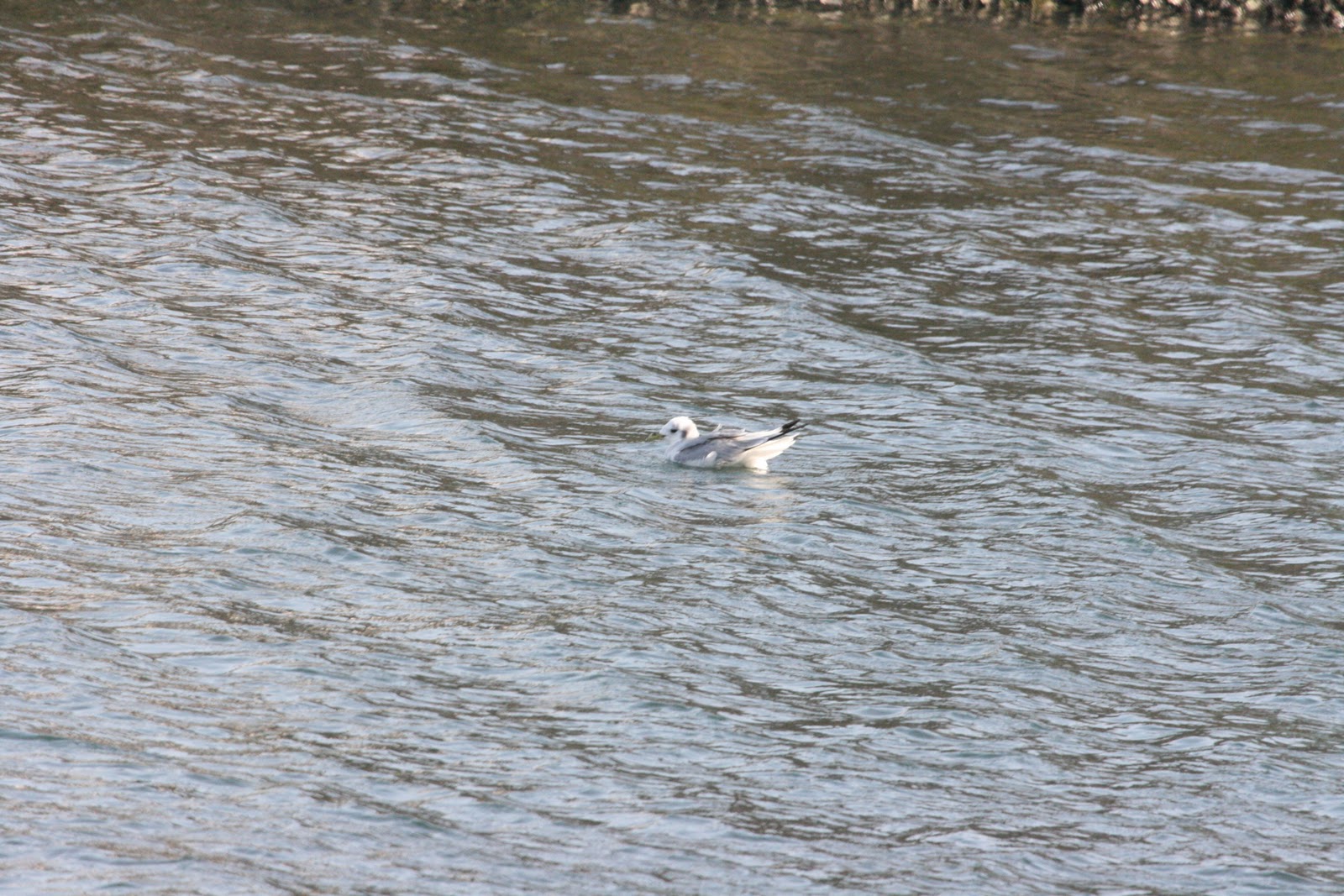
Black-legged Kittiwake Rissa tridactyla
Northern Lapwing Vanellus vanellus
Mandarin Duck Aix galericulata
  Earlier in the week in Seogwipo (MP only), a riverside park held about 50 Mandarin Ducks, a dozen Pale Thrush, two dozen Dusky Thrush, a White's Thrush, a female Red-flanked Bluetail, several Daurian Redstarts, while plentiful Great Tits and Japanese White-eyes made the bushes come alive. There has been a Eurasian Siskin explosion on Jeju this winter. In 2009, I saw none, in 2010 I spotted several, whereas this year I have noticed large flocks (40+) in several locations.
  A Black-legged Kittiwake and three dead and oiled Black-throated Loons were spotted in the harbour.
  In a farmer's field at Hanon Crater, a massive Greater Spotted Eagle lazily fled from the relentless attacks of a Eurasian Magpie. An Eastern Buzzard also glided over the field.

(*Note: This is a “historical post.” Whereas I started birding in Korea in 2005, this blog has only been active since early 2012 - these posts are an attempt to consolidate my early birdventures from the various blogs and websites where they reside, largely from the “Archived Bird News“ section of Birds Korea’s excellent website: http://www.birdskorea.org/Birds/Birdnews/BK-BN-Birdnews-archive.shtml. Find more historical posts by clicking on the "Historical posts" tab at the bottom of this post.
  For this post, most of images are lamentably poor-resolution screensaves, as many of the original photo files were lost in the infamous computer crash of 2011.)