Wednesday, July 22, 2015

Bar-headed Goose!

Hadong
Goose grounds
Getting his goose
Bar-headed Goose Anser indicus
Yellow Bittern Ixobrychus sinensis
Greater Painted Snipe Rostratula benghalensis (male)
Greater Painted Snipe Rostratula benghalensis (female)
  Ok I know I just wrote about how twitching is a waste of time (something a dipper would say), go bird your patch blah blah - but it's ok if the twitch is in your patch...right? Got the news on Friday from Tim that Korea's second (or is it?) Bar-headed Goose had turned up in nearby Hadong, so of course on Saturday morning that's where I was. Dr. Moores, Jason, and Ha Jeong Moon also showed up, and we had a nice long look at the goose, while debating its possible origins. We then hit my patch in Suncheon to look for some interesting typhoon-blown terns (Gull-billed, Whiskered) I'd spotted recently. More on them in an upcoming post. We didn't see any terns, but ended up spending time with some lovely Yellow Bitterns, as well as a surprise pair of Greater Painted Snipes. Read the proper reports here: 
Jason's trip report 
Dr.Moores on Bar-headed Geese
  In other news, my obsessive quest for the mythical Watercock (ha ha) continues... 

Thursday, July 16, 2015

Double-dipping Part 1 AKA Just Stick to Your Patch

Ferry to Nami Island
Gapyeong
Tim, birding
Black Woodpecker holes...minus the Black Woodpeckers
Grey-headed Woodpecker Picus Canus
Young Large-billed Crow Corvus macrorhynchos, begging
Siberian Chipmunk Eutamias sibiricus
Eurasian Nuthatch Sitta europaea
Black-naped Oriole Oriolus chinensis
  Lured by the tantalizing prospect of potentially seeing five lifers (Ruddy Kingfisher, Black Woodpecker, Northern Boobook Owl, Eastern Tawny Owl, and Northern Scops Owl), I hauled my tired carcass up to Gapyeong, via Seoul, in the ungodly wee hours of June 27th. Just outside of town lies Nami Island, a lenticular wooded spot that is clogged with selfie-stick-wielding tourists. For some reason, the five aforementioned species, which are local and hard to see in Korea, regularly summer on the busy island.
  A key factor that contributed to my decision to brave the logistical morass that is Seoul was the prospect of meeting up with fellow Birds Koreans and all-around good eggs Tim and Subho. Seeing Tim again was a treat, and we had a grand old time bantering about birds, Koreans, and everything in between.
  The first sign of trouble on Nami was the conspicuous lack of Korean birding paparazzi. The rare and twitchable birds of Nami are like honey to the swarms of camouflaged Korean guys with massive lenses, no binoculars, and often questionable fieldcraft/ethics. We wandered through the gaudy crowds for hours in a vain effort to spot one of the island's rarities, but the grim reality was evident fairly soon on - I'd waited perhaps one or two weeks too long to head up there, and the young birds had apparently already fledged and left the island.
  Not wanting to admit defeat, I told Subho to stay home, said my goodbyes to Tim, and got a room in dumpy and unfriendly Gapyeong. I was up before dawn on the 28th, and headed up a promising mountain in the hopes of running into a Ruddy Kingfisher. Awesome dawn chorus, but nothing crazy. I then made my way back through Seoul and headed home.
  What's the moral of this tale of woe? Don't twitch. Stay home and explore your own patch. Visit promising spots repeatedly, even if there are no interesting birds on a given day. Look at Google Earth, and think like a bird. Every spot has interesting birds moving through it at some point. Go find them.

Wednesday, July 8, 2015

Breeding Ashy Minivet update


female Ashy Minivet Pericrocotus divaricatus (Gageo Island, May 2013)
  It would seem that my weekend sighting of juvenile (therefore a breeding record) Ashy Minivets is potentially not the first Korean summer/breeding record for the ROK - but it is at least the most recent, and at best "the first adequately-documented breeding record for the whole of the Korean peninsula!" Details, and plenty of them, can be found in the comments section under the report on the Birds Korea blog:
http://www.birdskoreablog.org/?p=16166#comment-22577

Sunday, July 5, 2015

A Return to Goheung, July 4-5, 2015 (Rare South Korean summer/breeding record for Ashy Minivet!)


Black-capped Kingfisher Halcyon pileata
juvenile Ashy Minivet Pericrocotus divaricatus
  A return trip to Goheung has once more yielded some very interesting birds. Goheung is rich in a variety of habitats, ranging from mixed mountain forests, tidal mudflats, small sandy beaches, vast tracts of scrub-fringed rice fields, weedy reservoirs, and impressive stretches of reedbeds.
  The undoubted highlight of the trip was found after a 45-minute hike up a quiet mountain trail, amidst mixed deciduous/coniferous forest. The distinct trill of Ashy Minivets rang across a valley, and a dramatic scene was soon witnessed in glimpses through the dense foliage. Two Eurasian Jays seemed to be harrying at least two juvenile Ashy Minivets, while one, more probably two, adult birds flew back and forth repeatedly, calling urgently.
  This is apparently the first summer/breeding record for the ROK for close to 20 years. The call of the juvenile birds was weaker yet more urgent than that of the adults, which may explain the strange ‘minivet-like’ call I heard coming from a nearby valley on June 13th. This encounter brought to mind several Ashy Minivets (?) heard calling on a mountain near downtown Suncheon on June 7th. Were these birds late migrants, or perhaps something else?
  Earlier in the day, while driving through a small town, a Black-capped Kingfisher was seen casually perched on wires by the side of the road. It eventually flew down to a wooded area near some rice fields. I had forgotten what large and impressive birds they were!
  As when I visited on June 13-14, the mountains were bustling with juveniles – young Great, Varied, Long-tailed, and Coal Tits, Eastern Crowned Warblers, Yellow-throated Buntings, and Pale Thrushes were all seen trying out fresh wings and skills. Two pairs of Black Paradise Flycatcher, and at least five Fairy Pittas were heard in the hills on that earlier trip, but not on this more recent visit. A tiny Ussuri Mamushi Pitviper was also seen along the mountain trail. At lower elevations, it was great to see seemingly very healthy summer populations of Chinese Sparrowhawk, Striated Heron, Black-naped Oriole, Oriental Dollarbird, Little Ringed Plover, and Meadow Bunting. Goheung is an exciting and special place to go birding – I will try to return as often as possible, as there is so much great habitat and potential there.

Tuesday, June 16, 2015

More Southern Peninsular Exploration - Goheung, June 13-14, 2015


Bikin n birdin once more
Blue Rock Thrush Monticola solitarius
Yellow-throated Bunting Emberiza elegans
Coal Tit Periparus ater
Frog-eating Rat Snake (Red-backed Rat Snake/Chinese Garter Snake) Oocatochus rufodorsatus 
Young Barn Swallows Hirundo Rustica
Meadow Bunting Emberiza cioides
Little Ringed Plover Charadrius dubius
Varied Tit Sittiparus varius (juvenile - note the grey underparts - brown in adult birds)
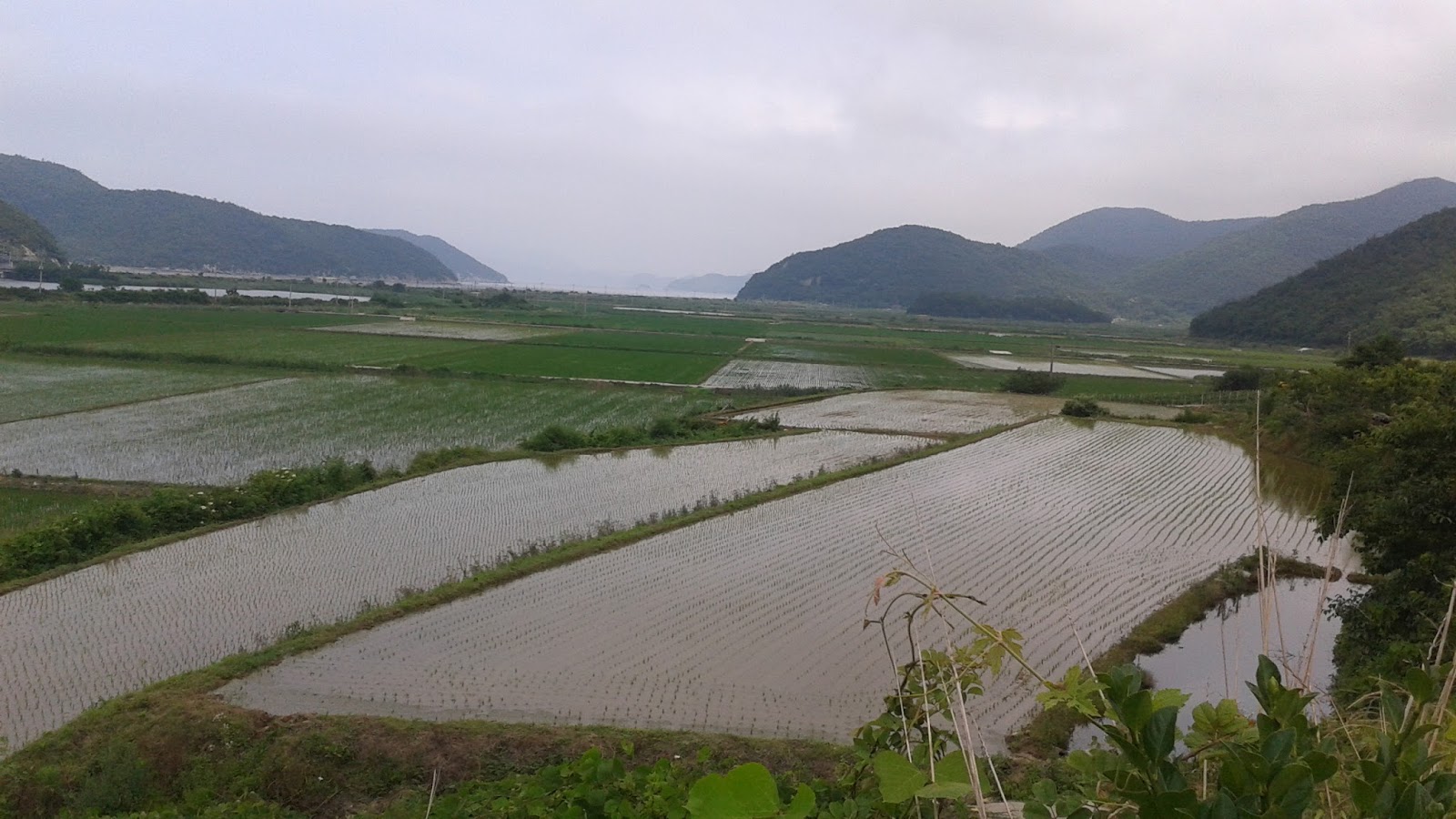
 Several satellite-bearing rockets have been launched from Goheung, which has led to it being branded as a silly futuristic rocket-land. That image couldn’t be any further from the truth. Goheung is in fact the most ‘old-fashioned’ bit of mainland Korea I’ve come across. Very little development, and countless valleys filled with stepped rice fields fringed not with concrete ditches, but with wild and overgrown scrub. 
  I forgot to take pictures of the endless miles of pristine reedbeds as we drove by, because I was busy staring in open-mouthed awe. Forget Suncheon Bay, this is where the reeds are. Most of the reeds are inaccessible, for better or worse, but one can only imagine the hordes of sexy bitterns and rails skulking happily within. Did I mention all the mudflats, quiet beaches, mixed mountain forests, and scrubby fields? The habitat on Goheung was mind-blowing. Can’t wait to see what will be found there during migration.
  June is a magical time in Korea - the hills of Goheung were peeping with the sound of newly-fledged juveniles. Young Daurian Redstarts, Common Pheasants, Barn Swallows, Eastern Crowned Warblers, Long-tailed Tits, Varied Tits, Coal Tits, Yellow-throated Buntings, and Tree Sparrows were seen on this trip, in all their clumsy drabness.
  A complete lack of calling cuckoos in the area felt notable – up until last weekend most hilly areas were ringing with the calls of 2-4 species. The first species I heard after pulling in and shutting down was a Black Paradise Flycatcher – good start! Two pairs were heard, as well as at least five Fairy Pittas on the same mountain.
  Some species that I’m not used to seeing in Suncheon included three Little Ringed Plovers pacing a beach and nervously eyeing a menacingly-perched cat, a flyover pair of Mandarin Ducks, several Meadow Buntings, and a pair of Blue Rock Thrush.
  Also noteworthy were a pair of Tiger Shrikes, two Oriental Honey Buzzards, two Striated Herons, dozens of Cattle Egrets in various stages of breeding plumage, two Black-naped Orioles, three Chinese Sparrowhawks, a White’s Thrush whistling all night, and several plump Frog-eating Rat Snakes, which were lurking in rice fields teeming with tadpoles.
  At one point, while hanging out at a nice reedy patch at the base of some hills at dusk, I heard...’something’. There were Brown-eared Bulbuls shrieking away, so the aural waters were fairly muddy, but for one brief and quiet moment, I picked up a distant minivet-like trill coming from the hills that sounded more urgent and shrill than your average Ashy Minivet. I don’t even want to mention the name of the bird I think it most sounded like. Ryukyu Minivet. There, I did it. Or of course, it could have been nothing of the sort.
  In other news, I’m going back to Goheung this weekend.

Monday, June 8, 2015

Big Saturday

Loghry scans the valleys of Dolsan
"Local pajan and a celebratory cold beverage"
Fairy Pitta Pitta nympha
Azure-winged Magpie Cyanopica cyanus
Eastern Crowned Warbler Phylloscopus coronatus
Tiger Shrike Lanius tigrinus
Chestnut-cheeked Starling Agropsar philippensis (nesting)
Jason Loghry came to town on the weekend, and we hit it hard - an epic 15-hour birding session. Read his full report here:  http://www.birdskoreablog.org/?p=15959