Monday, October 12, 2015

Suncheon, October 2-11, 2015


Grey-headed Lapwing Vanellus cinereus
Yellow-breasted Bunting Emberiza aureola - an endangered species whose population has plummeted in recent years
juvenile Yellow-breasted Bunting Emberiza aureola
Amur Falcons Falco amurensis
Temminck's Stint Calidris temminckii
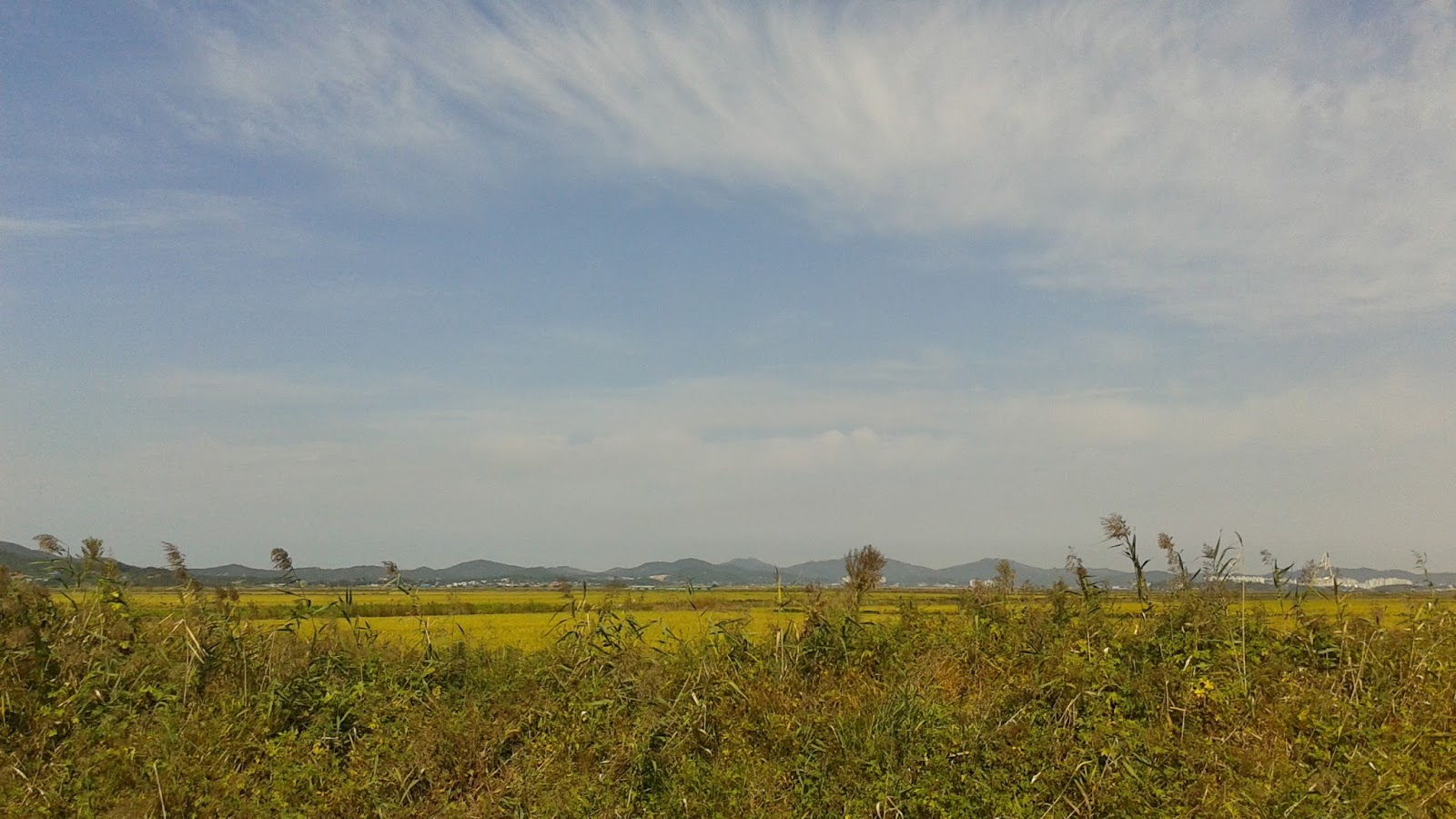
  It has been an exciting couple of weeks at Suncheon Bay, with a trickle of rarely-seen migrants and seasonal turnover keeping me on my toes. With winds regularly blowing down from the Bohai Bay, that feeling that ‘anything’ could turn up helps get me out of bed in the pre-dawn murk. On October 2nd, a strange sight for the bay was about 30 Brown-eared Bulbuls moving across the mudflats – do they seasonally migrate? Eight Stejneger’s Stonechats and a similar count of Far Eastern Cisticolas, an Arctic Warbler still, and three Yellow-breasted Buntings were highlights.
  Two days later, shorebird numbers, especially curlews and godwits, seemed to be much reduced. Pipits ruled several newly-harvested rice fields, with five Richard’s, two Pechora, and five Buff-Bellied Pipits seen. Two raucous Black-Browned Reed Warblers, a personal first for the site, and three Arctic Warblers were spotted in the coastal reedy scrub.
  October 6th marked a return of construction crews to the bay, who toiled noisily at digging up a former rice field. A relay of four dump trucks transported endless loads of muddy soil west to a growing heap near a solar energy farm. One wonders what these three new huge craters at this sensitive site will be used for. Water reservoirs? Foundations for massive new buildings? More solar panels? Sightings for the day included the first Little Grebe of the fall, a flyby Black-faced Spoonbill, four Northern Shovelers, three Northern Pintails, perhaps a half dozen Far Eastern Skylarks overhead, three Richard’s, four Pechora, and more than ten Buff-Bellied Pipits, at least ten Stejneger’s Stonechats, four Far Eastern Cisticolas, the Black-Browed Reed Warblers still, and two Yellow-breasted and two Black-faced Buntings. In addition, my run of mammalian luck continued, with my personal first sighting of an Amur Leopard Cat. Seen from fairly far off, it sat on a trail for a while, then stalked off into a ditch.
  On October 9th, ducks were increasing in number and variety, with more Shovelers and Pintails seen amongst the Mallards, Eastern Spot-billed Ducks, and Eurasian Teals. Moving inland to get away from construction noise and dust proved a fortuitous move. Three Amur Falcons were soon spotted hawking insects above the rice fields, and even eating them on the wing at times, Hobby-like. Several Common Snipes and pipits were put up as a result of the low-level activity. Best of the day was a juvenile Grey-headed Lapwing, which I almost stumbled over as I came around a corner on a small trail between rice fields. It gave spectacular flight views before dropping down into a nearby muddy pond, almost disappearing amidst the lapwing-coloured mud. It was well-watched for close to an hour as it casually paced, preened, and rested. High single-digit numbers of four pipit species (Richard’s, Pechora, Buff-bellied, and Red-throated) were seen in and over the fields, and the morning ended with several Black-faced and Chestnut-eared Buntings, and a Siberian Rubythroat that haltingly flushed across a path.
  The next day on nearby ‘Flying Squirrel Mountain,’ ten Oriental Honey Buzzards, four Grey-faced Buzzards, and two Northern Hobby were a treat to watch as they rode the wind currents. On the way down, a Japanese Sparrowhawk was seen at a grave site, as well as the season’s first six Olive-backed Pipits.
  A complete lack of swallows on the 9th was counterbalanced by renewed hirundine action overhead on the 11th, with about 40 Barn Swallows, half that number of Red-rumped Swallows, and three Sand Martins feeding over the fields. Other notable sightings included a Northern Hobby, two Amur Falcons still, and a drab Temminck’s Stint mixed in with eight slightly-larger Red-necked Stints. A single Grey-faced Buzzard flew across the bay headed southwest. A rare day off for the construction crews meant a mercifully quiet morning, and a renewal in small bird activity in the scrub around ‘the pit.’ A dozen Stejneger’s Stonechat now, with four Far Eastern Cisticolas sprinkled in, three Yellow-breasted Buntings (including what seemed to be a juvenile bird), a cracking male Chestnut-eared Bunting nearby, and a dozen Black-faced Buntings scattered among the ditches. Several Far Eastern Skylarks were heard overhead, and an Arctic Warbler lurked nervously in a small patch of coastal trees, where it has been since September 24th. 

Friday, October 9, 2015

Striking North - Seosan, September 27-28, 2015

Birding among forsaken monoliths
The fields of Seosan


Seosan Super Moon
This way to Birdland! Sigh.
Ridiculous 'Birdland'
Dreaded Chuseok traffic
Former Eastern Cattle Egret Bubulcus coromandus
Peregrine Falcon Falco peregrinus with lunch
Black-browed Reed Warbler Acrocephalus bistrigiceps
First-year Red-throated Pipit Anthus cervinus
Pied Avocet Recurvirostra avosetta
  Two weekends ago, Loghry and I took a much-needed bird trip over Chuseok, Korea's Thanksgiving. Our original plan to hit Gageo-do was scuppered by forecast high winds that would have meant trouble for the ferry, so we opted for Seosan, an agricultural coastal plain about halfway up South Korea's west coast. We started things out in Suncheon, scoping out my patch at the bay. Nothing too nutsoids, but duck variety and numbers were up, and it was fun picking through shorebirds with Loghry's scope. The trip north to Seosan was slowed to a crawl at times by the infamous Chuseok traffic, that sees 35+ million Koreans take to the roads. Ugh.
  Acting on some hot tips from fellow Birds Koreans, we checked a few spots that have been known to host Pheasant-tailed Jacana and Watercock (shakes both fists, muttering oaths) in the past, but it was most likely a touch too late in the year for those specials.
  The rice fields kept us busy as we picked through the many snipes and pipits skulking in ditches. We had quite a few Common Snipes, Buff-bellied Pipits, and a few Red-throated Pipits as well - always an exciting species to watch, although the first year birds can be tricky to separate from Buff-bellied, especially at a distance. A few pacing Black-faced Spoonbills were a welcome sight among the egrets, as Black-browed Reed Warblers skulked among the reeds.
  The bird of the trip was Jason's first (and my second) Pied Avocet. Gorgeous bird! "Th-Th-That's not a Shelduck!!" Giddy high-fives all-round.
  Visible for miles on a hillside was Seosan Birdland - a ridiculous eyesore that appears to be nothing more than another wasteful and poorly-conceived tourist trap. Busloads of visitors can gawk at stuffed birds, climb on giant fibreglass cartoon birds, play with touch-screens, and buy t-shirts and hot dogs on sticks. It doesn't appear that birders, the local landscape, or indeed birds were considered when this repugnant white elephant was birthed.

Sunday, October 4, 2015

Siberian Flying Squirrel

Siberian Flying Squirrel Pteromys volans
  While hiking a new mountain outside of Suncheon yesterday, I was lucky enough to have a rare encounter with a Siberian Flying Squirrel. These shy and mostly nocturnal critters are not often seen, but apparently the females and young sometimes feed during the day. A quick search online shows them listed as endangered in Korea (but not protected), and apparently they aren't meant to be found in this part of the peninsula.
  I spotted this one by almost walking into it - it was clinging to a tree at eye level, and for a moment I couldn't figure out what I was looking at. Slightly larger than a chipmunk, all I initially saw were the massive oil-drop eyes and a tangle of bunched-up armpit 'wings'. It eventually scuttled silently up the tree and watched me watch it for several minutes, before...lift-off. The squirrel repositioned itself a few times, then hurled itself off the branch. It fell straight down for a moment, then spread its limbs and swooped upwards, gliding expertly to a tree perhaps 50 feet away. It looked like a rectangular grey sheet of A4 paper, its tail flattened out and acting as a rudder. A truly stunning encounter - when it flew, I actually forgot to breathe for about 20 seconds. I feel very fortunate to have shared a moment with this exceedingly shy and gorgeous creature.

Monday, September 28, 2015

More August-September images

Lovely Suncheon Bay

Creepy zombie scarecrow army
Feather from Eurasian Jay wing coverts
'Please don't leave your garbage here'...Sigh... 
Terek Sandpiper Xenus cinereus with Grey-tailed Tattler Tringa brevipes
Giant noisy remote-controlled crop-dusting helicopter - really?!
Scruffy young Yellow-throated Bunting Emberiza elegans
Yellow-rumped Flycatcher Ficedula zanthopygia
Sand Martin Riparia riparia
Terrible record shot of a Grey-backed Thrush Turdus hortulorum
Far Eastern Curlew Numenius madagascariensis wing detail (with Barn Swallow flyby)
Common Snipe Gallinago gallinago
Black-winged Stilt Himantopus himantopus
Red-necked Stint Calidris ruficollis
Dunlin Calidris alpina
Terrible record shot of a Eurasian Wryneck Jynx torquilla
  Just got back from an exhausting 36-hour birding session with Jason Loghry. We hit Suncheon Bay and Seosan, about halfway up South Korea's west coast. Our original plan saw us spending several days on my favourite island for birding, Gageo-do.
  Unfortunately, the winds of fate and the...actual winds (gusting to 40 km/hr) conspired to keep us mainland-bound, as we couldn't risk being trapped there if the return ferry was cancelled. We had a few interesting birds turn up at Seosan, and it was a treat, as always, both to bird with Jason, as well as blabber on about birds with him.
  More on Seosan soon.

Saturday, September 26, 2015

Suncheon Highlights, August 8 - September 26, 2015

Suncheon Bay


Creeping around in the hills of Dolsan Island
Pechora Pipt Anthus gustavi
juvenile White-winged Tern Chlidonias leucopterus
Broad-billed Sandpiper Limicola falcinellus
Black-capped Kingfisher Halcyon pileata
Pied Harrier Circus melanoleucos
Long-tailed Tit Aegithalos caudatus
  It has been incredible to observe the gradual seasonal changes occurring at Suncheon Bay, a stunning and peaceful place at dawn. Unfortunately, at other times it is not so peaceful, with a wide range of disturbances spoiling the tranquility of the habitat used by large numbers of resident birds as well as migrating shorebirds. Picnickers using pedal cars to access quiet areas of the bay often leave behind heaps of garbage, much of which ends up blowing into the bay. On some days, a large (almost four metres long) and noisy remote-controlled crop-dusting helicopter was seen over the rice fields. It raced noisily up and down the fields adjacent to the bay, repeatedly putting up flocks of egrets and shorebirds. Additionally, large noisemakers on five-minute timers that produce shotgun-like booms where rice is being harvested have been heard for several weeks in Suncheon’s otherwise sedate rice fields.
  The endless disruptive construction work being done on the seawall finally seems to be tapering down. Unfortunately, the Eurasian Bittern seen on July 10th has not been seen since the heavy construction equipment moved into 'its' area shortly after that sighting. I sincerely hope this area adjacent to the eco-park stays closed to the general public. Thanks to the crowds, the well-touristed main park is already fairly unwelcoming to migrating birds. The agricultural areas around it are so vital to migrants, it would be calamitous if they were to be opened up to organized tourism, or developed further.
  On August 8th, several Raccoon Dog pups were spotted near the bay, as well as 50-60 Cattle EgretsAugust 26th saw a flyover male Black-winged Stilt, a Black-capped Kingfisher, and a Sand Martin mixed in with at least a hundred Barn SwallowsNotable at the bay on September 4th were two young ‘tigery’ Yellow Bitterns, and a reduction in both Cattle Egret numbers and colouration, with only seven mostly white individuals seen in the rice fields. Several Far Eastern Curlews were observed cleverly feeding on crabs on a small inland path. Another Sand Martin was seen with a 70-strong group of hirundines perched on power lines, mostly Barn Swallows with six Red-rumped mixed in. Two days later near the bay, observations included an Asian Brown Flycatcher, and another clumsy young Yellow Bittern.
  The following week, on the 10th, new arrivals at the bay included low double-digit numbers of Red-necked Stint, Common Snipe, White, Grey, and Eastern Yellow Wagtail, as well as a Eurasian HoopoeShorebird numbers continued to gradually swell. Only one Cattle Egret remained in a field where dozens had recently fed. The best bird of the day was also the first – an extremely early Short-eared Owl flushed from a ditch among rice fields just before dawn. Its underparts and side profile were seen well through binoculars as it flushed and flew low along the ditch. A pleasant surprise later in the day was the sight of at least 200 Barn Swallows sagging down power lines right outside my window, with several of them showing a pinkish wash to their underparts.
  On September 15th, dawn at the bay saw a female Black-winged Stilt, two Yellow Bitterns, still decent numbers of Eastern Yellow Wagtail, with Common Snipe numbers down to five. The day’s highlight was a juvenile White-winged Tern flying low just above the rice fields, deftly catching insects on the wing, and cavorting with Barn Swallows at times. This was my first time observing the species, and it was a real treat! No renewed sign of the Short-eared Owl on the 17th, and the White-winged Tern appeared to have moved on. The Black-winged Stilt, Red-necked Stints, Eastern Yellow Wagtails, and several Common Snipes remain, while several Far Eastern Cisticolas were seen and heard calling from high overhead. Three days later, a confiding Broad-billed Sandpiper was seen. It was seen again on the 23rd, along with an apparent Pied Harrier and Black-winged Stilt still, and a personal first Stejneger’s Stonechat of the fall.
  The morning of the 24th had a notably large congregation of Little and Intermediate Egrets spotted on a small waterway near the bay, totalling perhaps 70 birds. At least 250 Barn Swallows and several Red-rumped Swallows were seen intensely feeding where reeds give way to mudflats, presumably preparing for their long flight south. An Arctic Warbler seemed out of place on the seawall, flitting nervously through the scrub. 
  The morning also produced a memorable encounter with a bird I had seen only once previously. On the way out of the rice fields, a pipit flushed from the path in front of my motorcycle. I quickly shut down, coasted to a stop, and hunched behind the handlebars. To my delight, the bird, a cracking Pechora Pipit, walked along the ditch straight towards me, and I was able to observe it from very close range for several minutes. An incredible birding moment.
  Not much different on the 26th, with best being a Eurasian Wryneck. Shorebirds were represented by at least one hundred Black-tailed Godwits, and smaller numbers of Common Greenshank, Spotted Redshank, Red-necked Stint, Eurasian and Far Eastern Curlew, Whimbrel, Common Snipe, Terek Sandpiper, Pacific Golden Plover, Dunlin, Marsh Sandpiper, and the lingering Black-winged Stilt.
  Away from the Bay, a weekend trip to Dolsan-do on August 29-30th had several highlights - good flight views of a Grey Nightjar, seven Grey-streaked Flycatcher, a frustratingly quick look at a plain ‘olivey’ flycatcher (perhaps a female Blue-and-white?), eight Red-rumped Swallows still nesting in a small coastal town, and three Eastern Crowned WarblersOn September 8th, a female Yellow-rumped Flycatcher was spotted in a small ‘nursery’ woods next to a reservoir near Suncheon. Young Black-naped Orioles, Brown-eared Bulbuls, Azure-winged and Eurasian Magpies tested their wings under the watchful eye of several perched adult birds nearby. 
  Northwest of Suncheon on September 19th, aside from a band of confiding Long-tailed Tits, a lone Grey-backed Thrush was seen skulking in a tiny remnant of what was a lush quiet valley just three months ago. It has since sadly been reduced to a clear-cut moonscape, the wood sold for lumber by a land-owner that lives in Seoul.

Sunday, September 20, 2015

Butterflies of Korea - Part I

Asian Admiral Vanessa indica
Asian Comma Polygonia c-aureum
Asian Swallowtail Papilo xuthus 
Blue Admiral Kaniska canace 
Common Beak Libythea lepita
Common Bluebottle Graphium sarpedon
Pallas’ Sailer Neptis Sappho
Small Copper Lycaena phlaeas