Sunday, October 18, 2020

Sparrow School

American Tree Sparrow Spizella arborea

White-crowned Sparrow Zonotrichia leucophrys

Swamp Sparrow Melospiza georgiana

Fox Sparrow Passerella iliaca

Eastern Phoebe Sayornis phoebe

Ruby-crowned Kinglet Regulus calendula

Common Raven Corvus corax

Red-shouldered Hawk Buteo lineatus

Shagbark Hickory nuts?
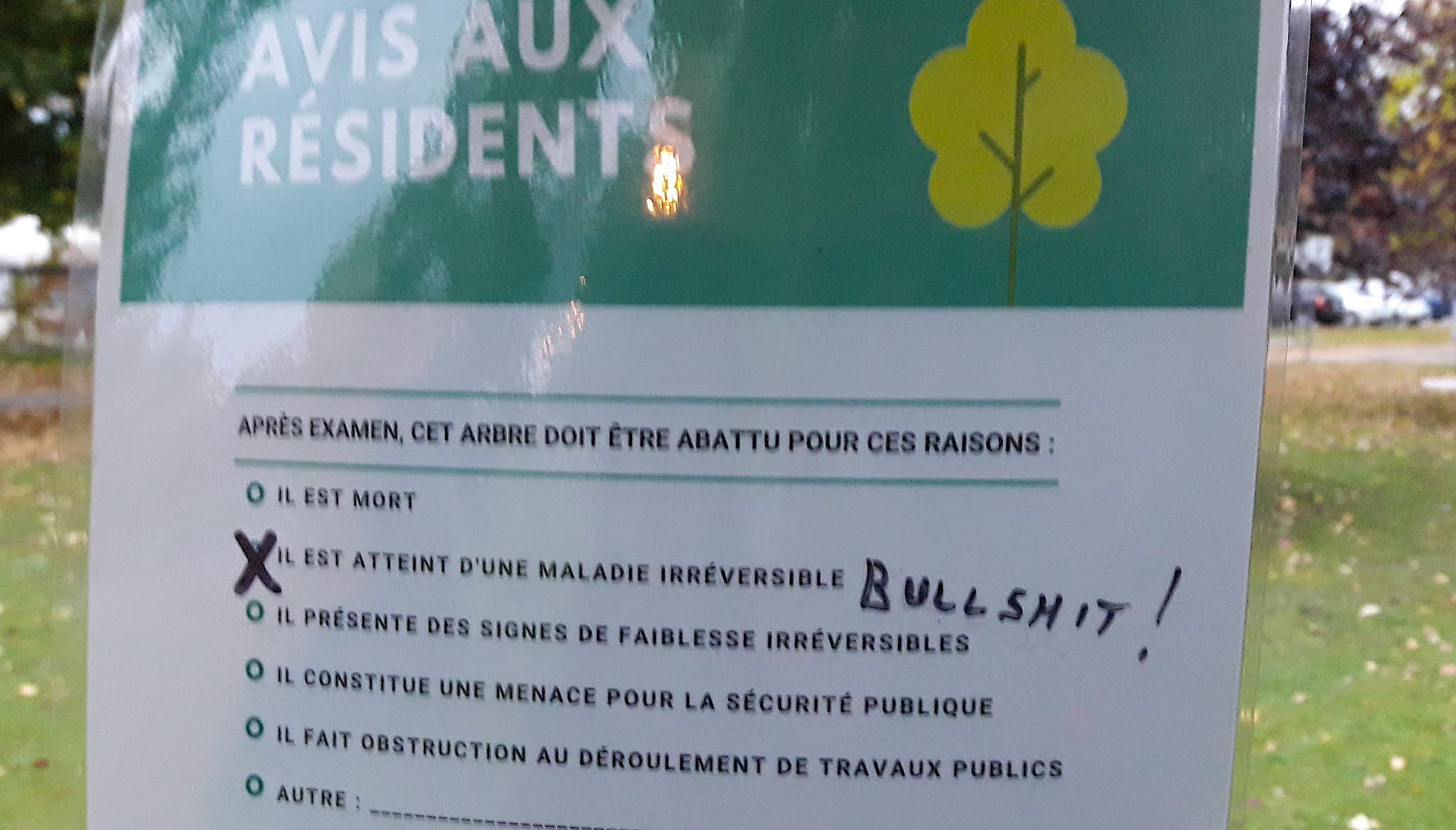
The placement seems odd...


  The parking areas at PN du Cap-St-Jacques were clagged up with happy families and clots of unmasked teenagers last weekend. Away from the scenic waterside vistas, there were plenty of quiet and un-Instagramable spots to be found. The birdiest patches were the shadowy trails that wound around a series of large, mostly fallow farm fields.

  These weed-choked fields were prime habitat for some of my favourites: LBJs…and boy, were the LBJs out and about! If we’re counting Juncos (Are we counting Juncos? Do we? Are we?) and the 'grand finale sparrow' that closed out the trip, nine species of sparrow were logged on the day. Welcome to Remedial Sparrow Identification School.

  At dusk, at the edge of a scrubby field near the farms on the northern bit, a sparrow was spotted that made my stomach fall into my shoes. Pale, straw-coloured, with an eye-line that joined up with the malar behind the eye to form a dark ‘U’…what the? My mind was racing, flicking through the pages of the various field guides in my mind. A pale female Rustic Bunting! Yes, it must be! Then I remembered I was not in Korea. Brewer’s Sparrow? Nope…that map isn’t right…Clay-colored Sparrow! 100% yes. And it was in no way, shape, or form a Chipping Sparrow.

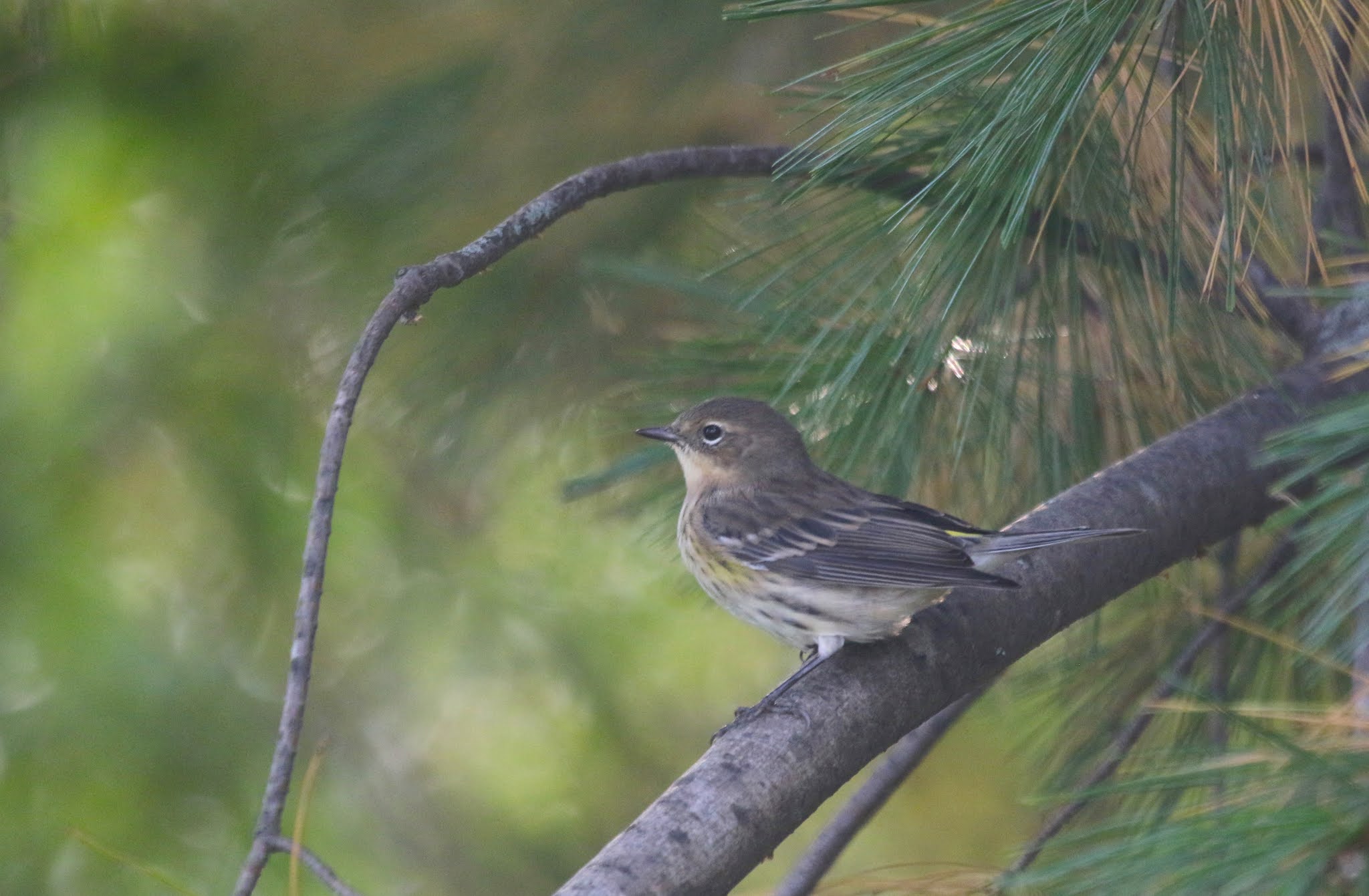
  I got solid looks at it through the bins for a while before I remembered the camera slung over my shoulder. I got on it, and saw the bird filling the frame in perfect focus…for a split second. Then the clump of weeds in front was in perfect focus…followed by the clump of weeds behind the bird. Autofocus hell, I call this. When I lowered the lens to switch to manual focus (damned tiny switches), the bird flipped into a hedge-line that was quivering with other sparrows, as well as half a dozen active Yellow-rumped Warblers for added flavour, never to be seen again. We lingered long after the light had leaked over the horizon, with no re-sighting. That’s birding, eh?

  Looking at the range maps, you gotta wonder if Clay-colored Sparrows are an overlooked species at this time of year, when they are drab, not singing, and mixed in with loads of other sparrows. Anyway, without having secured a record shot, I shall meekly mumble this record out, and should couch the sighting in more uncertain terms. One must never shout CCSP in a crowded theatre. Wait, I guess there are no more crowded theatres.

PN du Cap-St-Jacques, October 11, 2020
Canada Goose-50+
Mallard-12
Cooper’s Hawk-1 harassing the RSHA
Red-shouldered Hawk-1 adult
Herring Gull-1
Downy Woodpecker-1
Hairy Woodpecker-1
Northern Flicker-1
Pileated Woodpecker-2
Eastern Phoebe-2
Blue Jay-4
American Crow-3+
Common Raven-2
Black-capped Chickadee-8
White-breasted Nuthatch-4
Red-breasted Nuthatch-1
Golden-crowned Kinglet-7+
Ruby-crowned Kinglet-5+
Hermit Thrush-1
American Robin-8+
Nashville Warbler-1
Yellow-rumped Warbler-10+
Northern Cardinal-2
Clay-colored Sparrow-1
American Tree Sparrow-4
Song Sparrow-7
Lincoln’s Sparrow-1
Swamp Sparrow-1 hopping along the trail with tail cocked
Fox Sparrow-2
White-crowned Sparrow-12+ (conservative count…they were in most fields)
White-throated Sparrow-10+
Dark-eyed Junco-8+
Purple Finch-2

Monday, October 12, 2020

Lincoln’s Park

Lincoln’s Sparrow Melospiza lincolnii

Lincoln’s Sparrow Melospiza lincolnii

Lincoln’s Sparrow Melospiza lincolnii

Song Sparrow Melospiza melodia

Yellow-rumped Warbler Setophaga coronata

Blackpoll Warbler Setophaga striata

Blackpoll Warbler Setophaga striata

Yellow-bellied Sapsucker Sphyrapicus varius

Ring-billed Gull Larus delawarensis

Great Blue Heron Ardea herodias

Canada Goose Branta canadensis

American Wigeon Anas americana
(female-type)

American Wigeon Anas americana
(male just starting to come out of breeding plumage)

Bumblebee sp.

Swarms of tiny flies in odd chimney formations

The Sparrow Bowl


All masks, all the time


  A three-hour amble around Parc des Rapides turned up some notable avian observations. Several thick veins of Yellow-rumped Warblers moved through the treetops, seemingly in hot pursuit of tiny flies that were swarming above the treeline in bizarre chimney-like appendages. Three Blackpoll Warblers were spotted moving within these otherwise mono-specific groups. Each individual looked quite different from the other (much variation in the streaking on the underparts), each posing initial identification problems…especially with the hyper-active butterbutts (YRWA) running interference.

  In an underbrush-clogged depression feature near the parking lot (that I have dubbed ‘Sparrow Bowl’), two lovely confiding Lincoln’s Sparrows offered up excellent field mark comparisons with several nearby Song Sparrows. Other birds of note included a re-sighting of Canada Goose X6F2, close views of American Wigeons in fall plumage (never did manage to see one in Korea), and a juvenile Yellow-bellied Sapsucker flying figure-eight aerobatics through the trees, perhaps in reaction to a perceived threat.


Parc des Rapides, October 6, 2020
Double-crested Cormorant-25+
Great Blue Heron-2
Canada Goose-50+ (including neck collar ‘X6F2’)
Wood Duck-12+
Mallard-8
American Wigeon-4
Red-breasted Merganser-4
Ring-billed Gull-60+
Yellow-bellied Sapsucker-1
Northern Flicker-1
Blue Jay-1
American Crow-2
Black-capped Chickadee-12+
White-breasted Nuthatch-2
Golden-crowned Kinglet-2
American Robin-1
Yellow-rumped Warbler-30-40
Blackpoll Warbler-3
Northern Cardinal-2
Song Sparrow-20-30 (many first-year birds hopping around the weeds)
Lincoln’s Sparrow-2
White-throated Sparrow-3

Thursday, September 24, 2020

Warblers onze

Gray-cheeked Thrush Catharus minimus

Swainson’s Thrush Catharus ustulatus 

Bay-breasted Warbler Setophaga castanea

Orange-crowned Warbler Vermivora celata 

Northern Cardinal Cardinalis cardinalis
(looking rather pathetic sans crest)


American Black Duck Anas rubripes 

Wood Duck Aix sponsa 


  A three-hour bimble around Île-de-la-Visitation yesterday produced a decent assemblage of fall migrants. Thirty-seven species were seen, with 11 warblers among them. Close views of two Gray-cheeked Thrush provided a timely refresher on how to separate them from other catharus thrush species. 

  A plain warbler had me thinking Tennessee Warbler, but when I saw the streaky vest, yellow vent, broken eye-ring and long eye-line/supercilium, and apparent lack of wing bars, I was swayed towards Orange-crowned Warbler. I know Tennessee can have one or more of those field marks, but I’ve yet to see a Tennessee with all of them.

  Other warbler highlights included excellent views of a confiding Bay-breasted Warbler hawking insects several feet away, and relatively abundant Northern Parulas.

Warblers onze:
Orange-crowed Warbler-1
Northern Parula-8
Chestnut-sided Warbler-1
Magnolia Warbler-5
Cape May Warbler-2
Black-throated Green Warbler-1
Yellow-rumped Warbler-5+
Bay-breasted Warbler-4
American Redstart-1 male
Ovenbird-1
Wilson’s Warbler-1

Monday, September 21, 2020

Cems again

Common Raven Corvus corax with Turkey Vulture Cathartes aura 

Blackpoll Warbler Setophaga striata 

Northern Parula Setophaga americana 

Swainson’s Thrush Catharus ustulatus

Canada Warbler Cardellina canadensis 
(giving my camera the ol' cloaca salute)

Find the Brown Creeper Certhia Americana

Cooper's Hawk Accipiter cooperii

Eastern Cottontail Sylvilagus floridanus


George modelling his Wunderbird hoodie

 Up until two days ago, it had been about nine months since I’d birded the cemeteries. That’s weird, I guess, but it’s been a weird year, eh. George was able to rouse me from my hermitage for a lazy bimble round the mount in search of Gray-cheeked Thrush, which he needs for his cem list. We got out at ‘the circles’ on Mountain View, and I have to admit, I was rusty for the first few minutes. A confiding Northern Parula quickly blew the cobwebs out, and I wandered over to a bluff to check for skulkers. A catharus thrush popped up to eye level and offered close views through the bins. Ah, a Swainson’s Thrush with no spectacles…or buffiness…and very cold grey colouration throughout…then it was gone. Something didn’t add up, so I grabbed my Sibley’s to double-check and…yup. A Gray-cheeked Thrush. D’oh. I felt bad for not alerting George right away, and worse when we didn’t spot any at my ‘guaranteed GCTH spots.’ Ah well, that’s birding, eh.

  Over the lookout north of the cems, it was cool to watch as a Common Raven and a Turkey Vulture had a friendly contest to see who could soar in tighter circles.

  Other highlights included a flighty Canada Warbler (I seem to always spot them on the same day as GCTH), great close looks at a ground-foraging Blackpoll Warbler, and a Yellow-bellied Flycatcher — apparently it’s a good year for them. We logged 36 species in total. Several Eastern Cottontails, including a kit, were also seen at ‘the circles,’ my first for the cemeteries.

  All in all, it was a lovely afternoon out on the mountain. The leaves on some trees were already fully aflame with autumn’s fires, and gloves were needed at times, as it was crisp at times up there. The promise of winter is definitely in the wind (I reckon I use that line a lot). I’ve mentioned it before, but after breathing the foul yellow-grey skies of Korea on my last sojourn there, I will never take Canada’s gorgeous fresh air for granted.